
Choosing the right bumper guard isn’t just about appearance—it’s about how well your truck is protected in real-world driving. Whether you’re navigating daily roads, job sites, or off-road terrain, front-end damage can quickly lead to expensive repairs and unexpected downtime. By comparing a full grille guard vs center guard, you can better understand which option fits your driving conditions and risk level. The right choice helps protect critical components like your radiator and headlights while reducing the chances of costly damage from debris, wildlife, or minor collisions..
Why compare a full grille guard vs center guard for your truck?
You should compare a full grille guard vs center guard because your choice directly affects how well your truck is protected in different driving conditions. Whether you’re dealing with daily commuting, job site use, or off-road driving, each scenario presents different risks—from low-speed impacts to unexpected wildlife encounters. Understanding these differences helps you avoid choosing a guard that is either overbuilt for your needs or not strong enough to provide adequate protection.
Do you operate in high-risk wildlife zones?
Let’s be honest. If your routes pass through areas with high moose or deer populations, the total coverage of a full guard is often non-negotiable. These collisions frequently impact the corners of the vehicle, where center guards provide zero protection for expensive headlight assemblies.
- Wildlife Strikes: Full guards cover headlights and fenders.
- Urban Scuffs: Center guards handle low-speed bumps effectively.
- Fleet Uniformity: Standardization simplifies replacement parts inventory.
What is your primary terrain?
Think about it. Selecting the wrong equipment leads to either wasted fuel from excess weight or astronomical repair bills from inadequate shielding. Professional fleet managers must analyze their historical damage data before committing to a standardized guard style.
- Highway Fleets: Usually prioritize aerodynamics and weight.
- Logging/Mining: Require maximum structural integrity.
- Urban Delivery: May only need center-aisle protection for low-speed impacts.
Key Takeaway
Comparing guard types is not just about aesthetics; it is a strategic financial decision that impacts your long-term maintenance budget.
| Factor | Full Grille Guard | Center Guard |
|---|---|---|
| Coverage Area | Complete (Grille + Headlights) | Minimal (Grille Only) |
| Weight Impact | Higher | Lower |
| Installation | Multi-point Frame Mount | Simple Center Mount |
This structural comparison highlights how protection levels scale directly with the physical footprint of the guard on your vehicle’s front end.
What are the structural gaps in a full grille guard vs center guard?
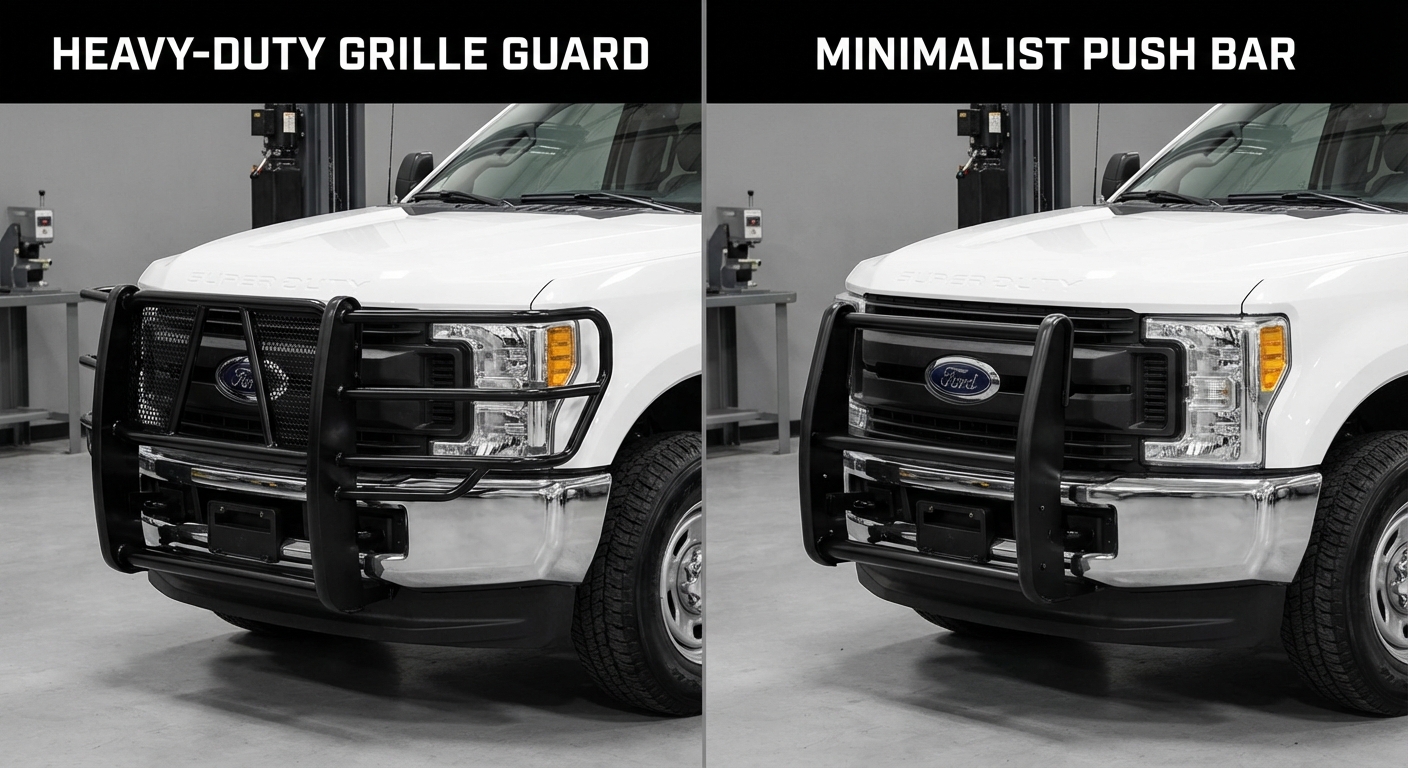
The primary structural difference in a full grille guard vs center guard lies in the coverage area, with the former spanning the entire front end including headlights. Full guards utilize side “brush” or “wing” sections that wrap around the vehicle’s corners to deflect debris and animals. Center guards, often called “push bars,” consist of two vertical uprights and a few horizontal crossbars located between the headlights.
Deciding between a full grille guard vs center guard requires understanding how the guard transfers energy to the frame during an impact. A full guard typically has more mounting points to stabilize the extended wings, whereas a center guard is a more compact, rigid unit.
How are the wings supported?
Think about it. The wings of a full guard are engineered to flex slightly under load to absorb energy without crushing the fender. These are often reinforced with horizontal bars that line up with the truck’s factory grille lines for a seamless look.
- Uprights: Vertical steel or aluminum pillars that take the brunt of the force.
- Crossbars: Horizontal tubes that protect the radiator and intercooler.
- Wings: Wrap-around sections designed for headlight and fender safety.
What about the mounting points?
Here’s the deal. A center guard typically attaches to the main frame rails with a few high-tensile bolts, making it a very rigid point of contact. This setup is excellent for pushing stalled vehicles but offers no lateral support for off-center impacts.
- Frame Rails: The primary anchor for both guard types.
- Gussets: Re-enforced joints that prevent weld failure during impact.
- Mounting Brackets: Custom-fit hardware ensuring a 100% fitment guarantee.
Key Takeaway
While center guards offer a streamlined profile, they leave the most fragile and expensive components—your headlights—completely exposed to damage.
| Structural Element | Full Guard Design | Center Guard Design |
|---|---|---|
| Main Uprights | Heavy-duty, dual-frame mount | Standard frame mount |
| Horizontal Bars | 3 to 4 full-width bars | 1 to 2 center bars |
| Wrap-around Wings | Included for side protection | Not available |
Structural differences define the guard’s ability to handle off-center impacts which are common in real-world driving scenarios.
How does impact vary between a full grille guard vs center guard?
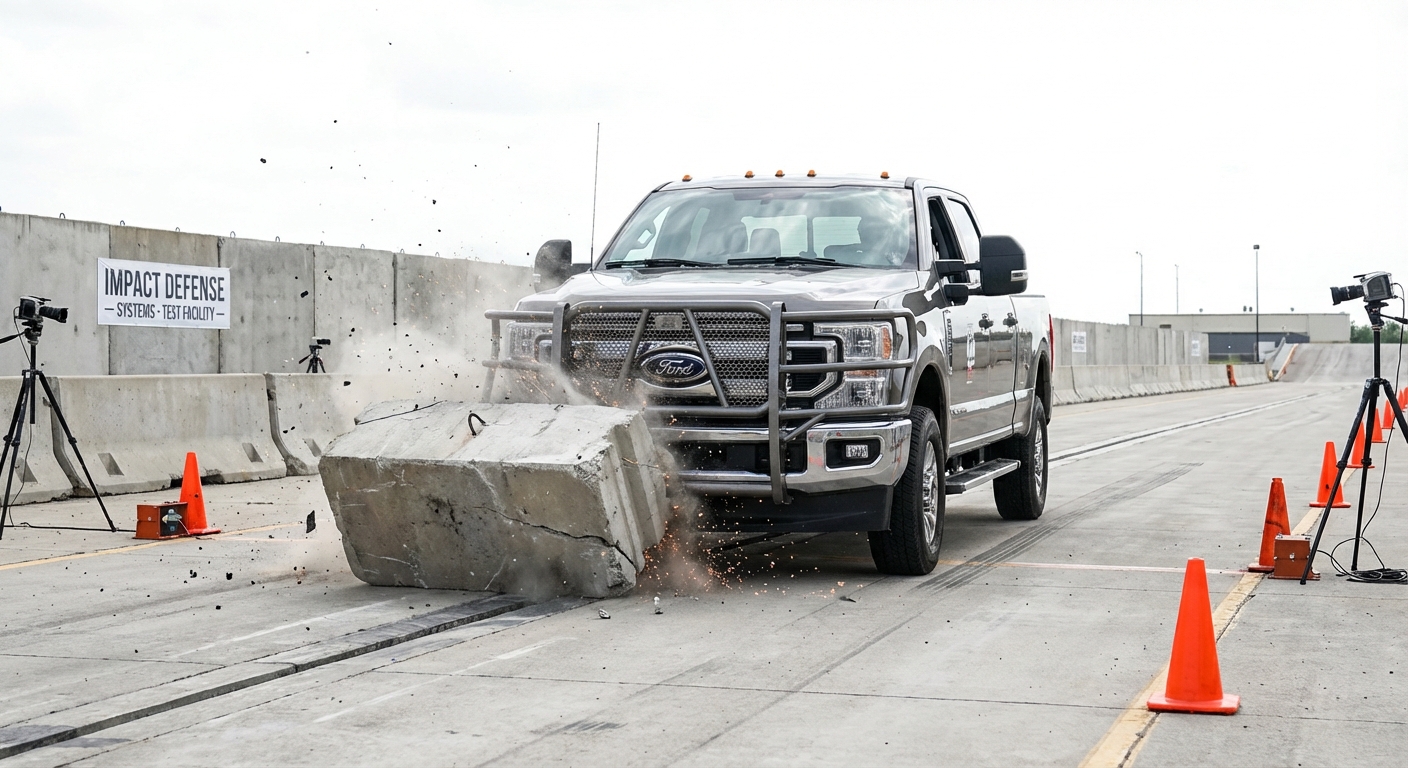
Comparing the impact protection of a full grille guard vs center guard reveals that full guards offer comprehensive shielding for headlights and fenders. Center guards are effective for low-speed “pushing” maneuvers but fail to protect against corner impacts that can total a modern truck’s front end. Full guards are designed to act as a shield for the entire fascia, preventing small objects and large animals from penetrating the engine bay.
If a deer hits the corner of your bumper, a center guard might as well not be there. Center guards are specifically designed to keep the radiator and intercooler intact during a frontal collision, ensuring the truck remains drivable.
Will a center guard protect my radiator?
It gets better. Yes, center guards are specifically designed to keep the radiator and intercooler intact during a frontal collision. This ensures the truck remains drivable so the driver can reach a safe location or a repair shop.
- Energy Dissipation: Full guards distribute force across the entire frame.
- Debris Deflection: Wrap-around wings push branches away from the glass.
- Component Longevity: Protecting sensors and lights reduces small-claim repairs.
How do full guards handle large animals?
Look at it this way. In high-speed collisions with large wildlife, the full guard acts as a crumple zone that redirects the mass away from the engine. This is critical for preventing “total loss” scenarios where the engine block or cabin is compromised.
- Mass Redirection: Deflecting the animal downward or to the side.
- Frame Protection: Absorbing energy before it hits the chassis.
- Reduced Downtime: Keeping the truck road-legal even after a strike.
Key Takeaway
Impact protection is a game of coverage; more surface area covered by high-grade material means fewer vulnerable points on your vehicle.
| Protection Metric | Full Grille Guard | Center Guard |
|---|---|---|
| Radiator Safety | Excellent | Excellent |
| Headlight Safety | Maximum | None |
| Fender Shielding | High | None |
The level of impact protection should be matched to the severity of the obstacles your drivers encounter daily.
Is a full grille guard vs center guard better for off-road use?
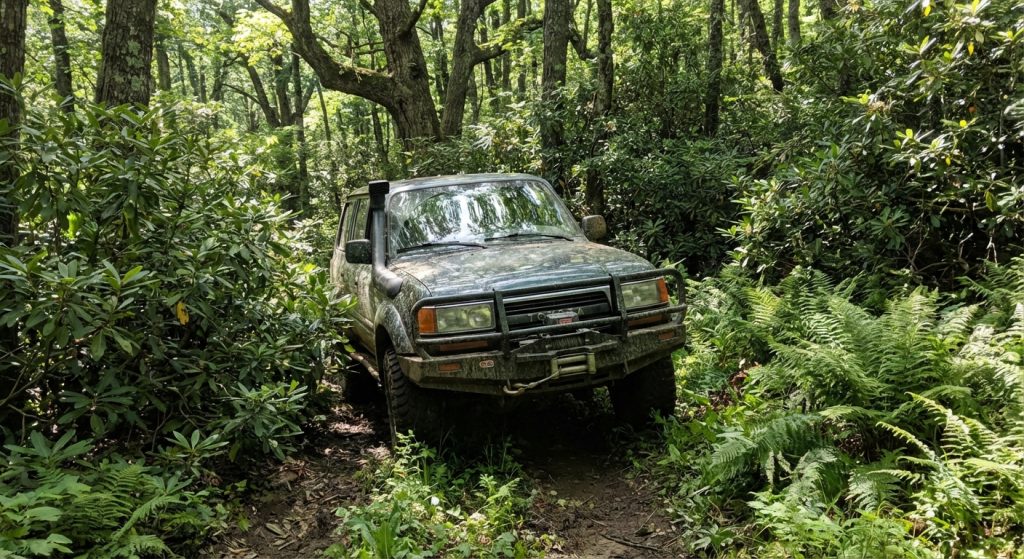
Selecting a full grille guard vs center guard for off-road use depends on the terrain, as full guards protect against side-swipe brush and center guards offer better approach angles. If you are navigating tight trails with heavy vegetation, the full guard’s wings will push branches away from your paint and headlights. However, for rock crawling or steep inclines, the added bulk of a full guard can sometimes decrease your clearance.
Selecting the right full grille guard vs center guard for off-road performance means weighing the benefit of brush protection against the cost of added front-end weight. A center guard keeps the front end light, which can improve suspension travel and steering response in soft sand or mud.
Does off-road vibration matter?
But wait, there’s more. Off-roading subjects your guards to constant high-frequency vibration that can fatigue mounting hardware over time. Full guards require robust mounting systems to ensure the wings don’t rattle or fatigue the frame over thousands of miles.
- Vibration Resistance: Thick-wall tubing handles washboard roads better.
- Mount Integrity: Extra contact points reduce leverage stress.
- Rust Prevention: High-quality finishes prevent corrosion in muddy environments.
Why choose a center guard for work sites?
As it turns out, center guards are often the preferred choice for industrial work sites where maneuverability is the top priority. They provide essential radiator protection without significantly increasing the vehicle’s turning radius or forward overhang.
- Improved Visibility: Less tubing in the peripheral vision.
- Access: Easier to reach the engine bay for field repairs.
- Weight: Minimizes front-axle wear during heavy hauling.
Key Takeaway
For most commercial off-road applications, such as logging or oil field service, the full guard is preferred to handle unpredictable obstacles.
| Off-Road Scenario | Recommended Guard | Primary Reason |
|---|---|---|
| Dense Forest | Full Guard | Brush deflection from lights |
| Desert/Sand | Center Guard | Reduced weight and better cooling |
| Mountain/Steep | Center Guard | Maximized approach angle |
Matching the guard to the terrain ensures you don’t compromise the vehicle’s inherent off-road capabilities while trying to protect it.
Does a full grille guard vs center guard offer headlight safety?
When evaluating a full grille guard vs center guard, the full guard is the superior choice for headlight protection because it includes side brush guards. Modern LED headlight assemblies are incredibly expensive to replace, often costing thousands of dollars per side. A center guard leaves these components entirely exposed, meaning a minor collision with a bird or a branch can result in a significant repair bill.
You are essentially deciding whether to insure your headlights or leave them to chance. In high-debris environments, the “wings” of a full guard act as a primary line of defense for these fragile electrical components.
How do wrap-around wings work?
Think about it. These sections are curved to follow the contour of the truck’s body, providing a physical barrier that prevents direct contact. They ensure that even if an object hits the side of the truck, the lens remains intact.
- Horizontal Protection: Bars prevent large objects from piercing the light.
- Vertical Support: Provides rigidity to the outer edges of the guard.
- Removable Options: Some wings can be removed for maintenance or replacement.
What is the cost of failure?
Surprisingly enough, replacing a single shattered headlight on a modern heavy-duty truck can cost as much as a high-quality center guard. When you lose a light, you also lose road legality, which can lead to hefty fines and service interruptions.
- Parts Cost: Modern LED assemblies are highly specialized.
- Labor Time: Installation often requires removing the entire grille.
- Downtime: Waiting for specialized parts can ground a vehicle for days.
Key Takeaway
If reducing repair costs for lighting and electrical components is your goal, the full guard is the only logical choice.
| Lighting Component | Full Guard Benefit | Center Guard Benefit |
|---|---|---|
| Headlight Lens | Physical Shielding | No Protection |
| Turn Signals | Wrap-around Coverage | No Protection |
| Fog Lights | Often Integrated | Sometimes Protected |
The data shows that headlight damage is one of the most common costs in front-end collisions, making the full guard a proactive financial shield.
Do sensors react to a full grille guard vs center guard?
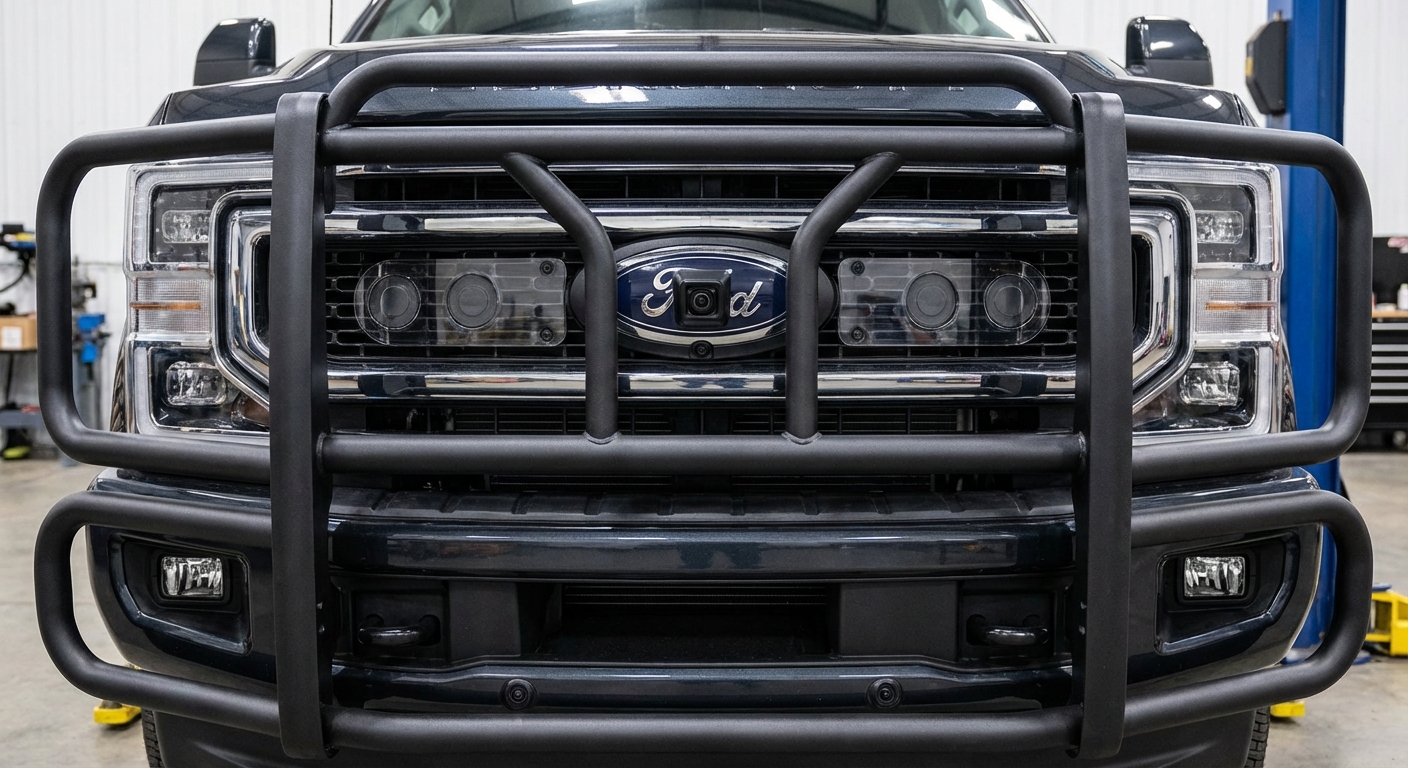
A full grille guard vs center guard can impact ADAS sensors differently depending on the tube placement and the specific sensor configuration of your truck. Most modern trucks use radar-based collision mitigation and camera-based lane departure systems located in the center grille. A center guard must be carefully engineered so its uprights do not obstruct the “field of view” of these radar units.
Professional manufacturers design their guards with “sensor-friendly” zones when building a full grille guard vs center guard. If the tubing is too thick or placed incorrectly, it can trigger false positives in your safety systems, causing the truck to brake unexpectedly.
Are parking sensors an issue?
The best part? Parking sensors on the corners of the bumper are often blocked by the wings of a full guard, requiring specific accommodation. You should look for guards that include sensor relocation kits or pre-drilled holes to maintain factory functionality.
- Radar Interference: Metallic bars can reflect signals back to the sensor.
- Camera Obstruction: Tubing may appear in the 360-degree camera view.
- Sensor Relocation: Necessary for maintaining Adaptive Cruise Control (ACC).
How to ensure sensor compatibility?
That’s not all. You must consult your vehicle’s technical manual to identify where each sensor is located before choosing a specific guard design. A reputable manufacturer will provide a list of compatible makes and models for each guard style.
- System Recalibration: May be required after installing heavy equipment.
- Field of View: The area the camera or radar must see to function.
- False Positives: When the system thinks an object is closer than it is.
Key Takeaway
Do not sacrifice safety technology for physical protection; ensure your chosen guard is compatible with your vehicle’s specific ADAS hardware.
| Sensor Type | Full Guard Impact | Center Guard Impact |
|---|---|---|
| Adaptive Cruise | Low (if centered) | Moderate (direct path) |
| Parking Sensors | High (wing coverage) | Low (center only) |
| Front Camera | Potential blockage | Potential blockage |
A technical audit of your truck’s sensor suite is mandatory before choosing a guard configuration to avoid safety system failures.
How do you maintain a full grille guard vs center guard?
Maintenance for a full grille guard vs center guard differs primarily in the surface area requiring inspection for rust or fastener tension. Because a full guard has more joints and a larger physical presence, it is more susceptible to loosening over time due to road vibration. Center guards are simpler and more compact, making them easier to clean and inspect during routine vehicle walk-arounds.
Using high-quality materials like polished stainless steel or powder-coated aluminum can significantly reduce the time you spend on corrosion control. For full guards, we recommend a torque check every 10,000 miles to ensure mounting hardware hasn’t backed out.
How often should I check bolts?
It gets better. For full guards, we recommend a torque check every 10,000 miles to keep the structure rigid and safe. The leverage exerted on the outer wings by wind and vibration can cause mounting hardware to loosen if not properly maintained.
- Cleaning: Full guards require more time to remove salt and grime.
- Rust Inspection: Focus on the weld points where the wings meet the uprights.
- Finish Care: Polishing stainless steel vs. touching up powder coat.
What are the common failure points?
Think about it. The most common issues arise from road salt and moisture becoming trapped in tight spaces where the guard attaches to the vehicle. Regular power washing and applying a protective sealant can extend the life of your guard by several years.
- Weld Fatigue: Cracks appearing in joints over many miles.
- Bolt Oxidation: Hardware that seizes and becomes difficult to remove.
- Finish Chipping: Small rocks can chip powder coating, leading to rust.
Key Takeaway
While full guards require slightly more attention, the trade-off in protection usually outweighs the extra ten minutes of inspection time.
| Maintenance Task | Full Grille Guard | Center Guard |
|---|---|---|
| Inspection Time | 15-20 Minutes | 5-10 Minutes |
| Corrosion Risk | Higher (More Welds) | Lower (Simple Design) |
| Hardware Count | 8-12 Bolts | 4-6 Bolts |
Maintenance schedules should be integrated into your fleet management software to prevent guard failure during a collision.
Is a full grille guard vs center guard more cost-effective?

Deciding which is more cost-effective: full grille guard vs center guard requires looking past the initial purchase price to consider potential repair costs. A center guard has a lower upfront cost, making it attractive for budget-conscious fleets or those with low-risk routes. However, a full guard can pay for itself in a single incident by preventing the total loss of a front-end module.
The “cheaper” option of a full grille guard vs center guard often becomes the most expensive over the lifecycle of the truck. You must calculate the Total Cost of Ownership (TCO) including insurance premiums and potential downtime losses.
Is the resale value affected?
Surprisingly enough. Trucks equipped with high-quality full guards often command a higher resale price on the secondary market. Buyers recognize the value of a vehicle that has been protected from road rash and minor impacts throughout its service life.
- Initial Investment: Center guards are 30-50% cheaper upfront.
- Insurance Savings: Some carriers offer discounts for full-frontal protection.
- Downtime Prevention: Avoiding a shop visit saves thousands in revenue.
How to calculate your ROI?
Here’s the deal. To calculate your return on investment, look at your repair bills from the last 24 months and see how many incidents involved the fenders or headlights. If more than 20% of your repairs occurred outside the central grille area, the full guard is the better financial move.
- Repair History: Use real data to drive your purchasing decisions.
- Downtime Costs: Factor in the cost of a replacement rental vehicle.
- Insurance Premiums: Will your rates drop with better protection?
Key Takeaway
Cost-effectiveness is measured by the money you don’t spend on repairs after the equipment is installed.
| Financial Factor | Full Grille Guard | Center Guard |
|---|---|---|
| Purchase Price | $$$ | $$ |
| ROI (First Strike) | Very High | Moderate |
| Maintenance Cost | Low | Very Low |
Analyzing your fleet’s accident history will reveal whether the higher investment in a full guard is justified by your typical repair expenses.
Does a full grille guard vs center guard affect fuel efficiency?
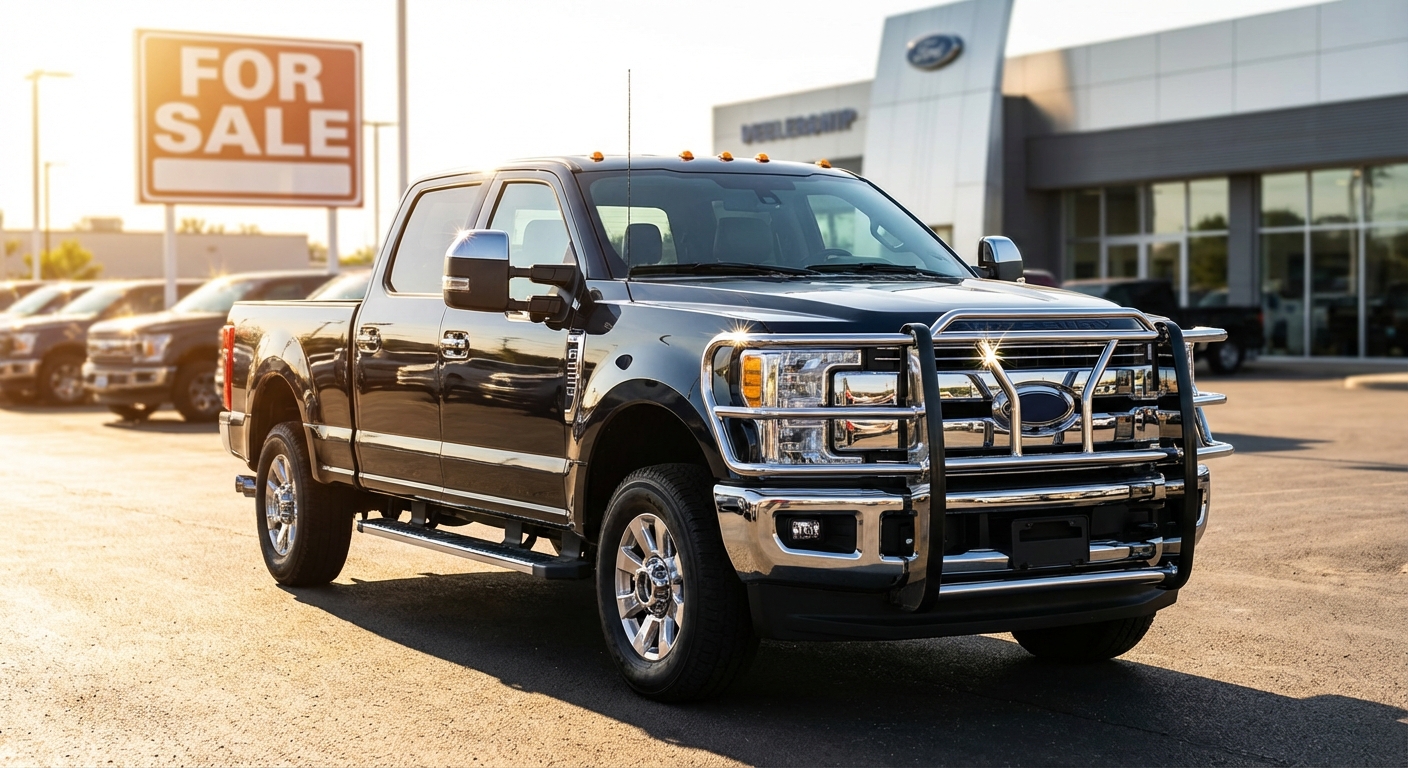
The aerodynamic profile and total weight of a full grille guard vs center guard can influence your fuel economy, particularly in long-haul highway applications. Full guards create a larger “footprint” in the air, which can slightly increase drag coefficients if the tubing is not aerodynamically optimized. Center guards are much more streamlined and add less weight to the front axle, typically resulting in a negligible impact on MPG.
Modern guard designs use oval tubing or angled crossbars to minimize this parasitic drag across the vehicle. While the difference is often less than 1%, for a large fleet, these small increments can lead to significant annual savings.
Does weight affect tire wear?
As it turns out. Heavy steel full guards can shift the weight balance of the truck forward, potentially leading to increased wear on front tires. This is especially true if the vehicle isn’t properly aligned after the additional weight is added to the front bumper.
- Aerodynamics: Center guards allow better airflow to the grille.
- Weight: Aluminum guards offer a “best of both worlds” solution for MPG.
- Fleet Impact: Small efficiency losses are magnified across large fleets.
Can material choice save fuel?
The best part? Switching from steel to high-grade aluminum can reduce the weight of a full guard by up to 40% without compromising structural integrity. This weight reduction directly helps in maintaining factory fuel efficiency levels while providing maximum protection.
- Aluminum: Lightweight and resistant to heavy corrosion.
- Steel: Maximum impact resistance but heavier on the axle.
- Hybrid Designs: Using steel for uprights and aluminum for wings.
Key Takeaway
Choosing an aluminum guard from our specialized line can mitigate weight-related fuel efficiency losses while maintaining maximum protection.
| Efficiency Metric | Full Grille Guard | Center Guard |
|---|---|---|
| Aerodynamic Drag | Moderate | Low |
| Added Weight | 150-250 lbs | 75-125 lbs |
| MPG Impact | Minimal (0.5-1%) | Negligible |
Fuel efficiency concerns are usually secondary to safety, but they should be factored into your long-term operational costs and environmental goals.
How to pick a full grille guard vs center guard for your truck?
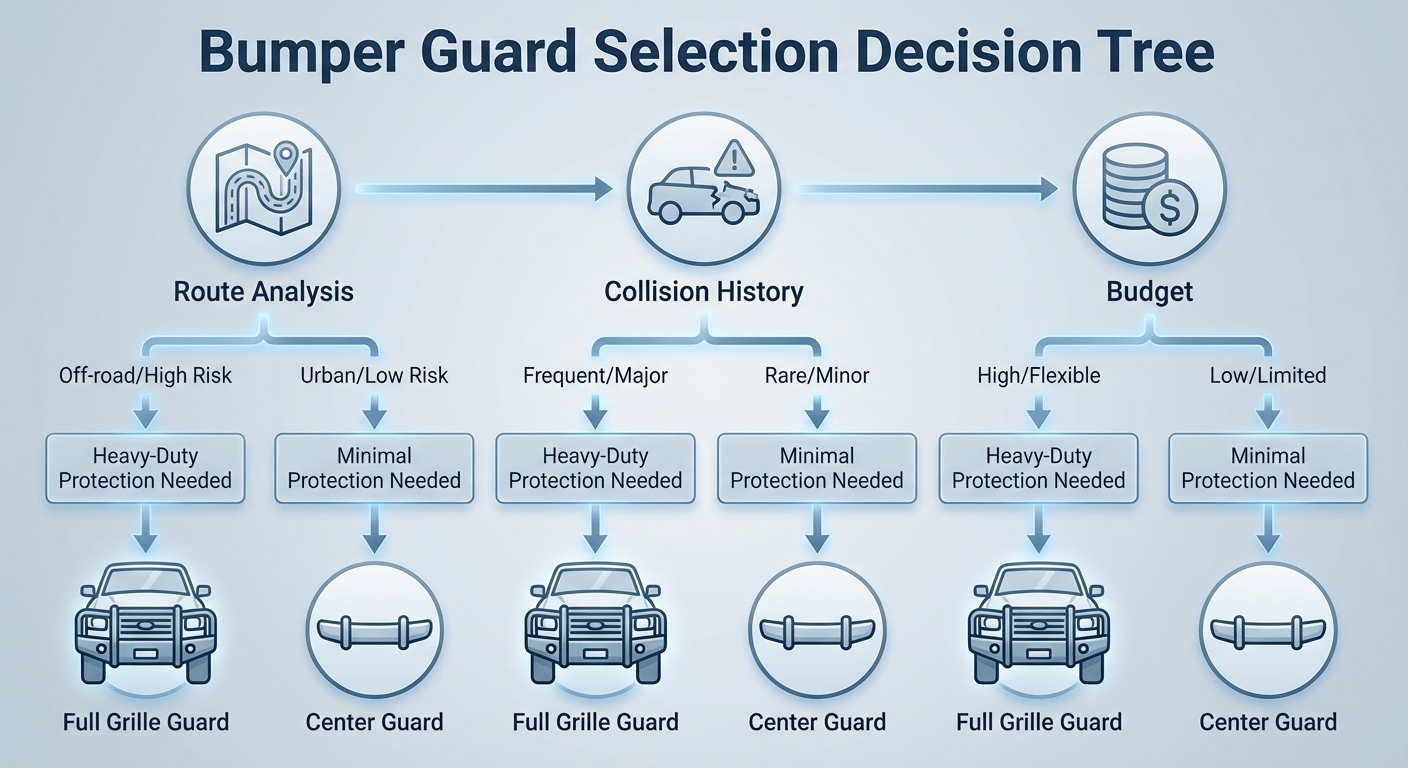
You can pick a full grille guard vs center guard for your truck by auditing your historical collision data and identifying the most common front-end damage points. If your drivers frequently report broken headlights or dented fenders from debris or animals, the full guard is your clear winner. If your primary concern is protecting the radiator during low-speed maneuvers in congested loading docks, a center guard may suffice.
You should also consult with your drivers to understand their visibility preferences and the specific hazards they encounter on their routes. Identifying a full grille guard vs center guard solution requires a balance of safety, weight, and operational reality.
Have you checked mounting compatibility?
Think about it. Before ordering, verify that the guard you choose is compatible with your truck’s make and model. Some OEM bumpers have specific tow hook configurations or fog light placements that limit your guard options.
- Collision History: Where does the damage usually occur?
- Budget: Do you have the capital for full-system protection?
- Route Hazards: Is wildlife or urban congestion the bigger threat?
What is the final step?
That’s not all. The final step is to reach out to a manufacturer that offers a 100% fitment guarantee and has experience outfitting fleets similar to yours. This ensures you won’t face unexpected installation delays or sensor compatibility issues after your purchase.
- Vendor Support: Look for companies that provide technical consultation.
- Warranty: Ensure the guard is backed by a long-term structural warranty.
- Customization: Some fleets require specific features like light tabs or winches.
Key Takeaway
The “right” guard is the one that prevents your most frequent types of damage while fitting seamlessly into your operational workflow.
| Step | Action | Outcome |
|---|---|---|
| 1. Audit | Review 24 months of repair bills | Identify damage patterns |
| 2. Survey | Ask drivers about route hazards | Understand environmental risks |
| 3. Consult | Speak with an expert | Determine fitment and material |
Your final decision should be a data-driven choice that prioritizes the safety of your drivers and the long-term integrity of your fleet.
*
Summary and Recommendation
Selecting between a full grille guard and a center guard involves balancing protection, weight, and budget. While center guards offer localized protection for the radiator, full grille guards provide a comprehensive shield for headlights and fenders, which are often the most expensive parts to repair after a wildlife strike. We solve these front-end protection challenges by engineering precision-fit guards that reduce downtime and maintenance costs. Our vision is to empower North American fleets with the most durable, high-performance truck protection on the market.
To protect your fleet and minimize operational downtime, contact us today for a custom quote or technical consultation.
*
Frequently Asked Questions
Can I install a full grille guard myself or do I need a professional?
While many of our guards feature a bolt-on design, we recommend professional installation for full guards to ensure proper frame alignment and sensor calibration.
What’s the best material for a guard used in salt-heavy northern climates?
High-grade stainless steel or aluminum with a heavy-duty powder coat is the best choice to prevent corrosion from road salt and moisture.
How do I know if a guard will interfere with my adaptive cruise control?
You should check the product specifications for radar-compatible mounting zones or relocation brackets designed specifically for your truck’s ADAS system.
Can I add extra lighting to a center guard?
Yes, most center guards include pre-drilled holes or mounting tabs specifically for auxiliary off-road or fog lights.
How do I know if my truck’s warranty will be affected by an aftermarket guard?
In most cases, a properly installed bolt-on guard does not void vehicle warranties, but you should always confirm with your fleet lease agreement or dealer.