
Modern vehicle bumpers absorb crash impacts by transforming destructive kinetic energy into controlled material deformation, but heavy commercial vehicles require specialized, high-integrity systems to distribute load across the truck’s frame rails. Picture yourself piloting a heavy-duty Class 8 transport truck down a dark highway during a winter storm when a sudden obstacle blocks the lane. If you are operating with an under-engineered factory setup, even a minor wildlife strike or collision with highway debris can cause immediate structural failure. The impact forces are transferred straight to your engine block, cooling packs, and chassis, leading to expensive towing fees, weeks of downtime, and massive repair bills. By investing in heavy-duty collision armor engineered with a scientifically optimized framework, you can direct these destructive forces away from critical assemblies and protect both your drivers and your physical capital. Implementing engineered solutions ensures that any impact force is managed through a balanced process of material yield and strategic truck bumper load distribution across your vehicle’s frame.
Why is truck bumper load distribution key to crash survival?
Strategic force dispersion during a collision prevents localized pressure spikes from crushing occupant compartments and critical engine blocks. Implementing optimized truck bumper load distribution processes ensures that the extreme kinetic energy generated during a Class 8 collision is safely routed around the cab structure. When your vehicle undergoes an impact, the energy must be managed progressively rather than stopping the truck instantaneously.
By dispersing this energy across a wider surface area and channeling it toward the strongest parts of your truck, you can dramatically lower the peak deceleration forces. This scientific approach prevents the chassis from absorbing the entire force in one concentrated, destructive zone. It keeps your primary vehicle structures intact while saving lives in the cabin.
Physics of High-Velocity Energy Transfer
To understand how heavy-duty armor works, you must look at the mathematical relationship of kinetic energy and momentum. During a collision, the sudden momentum change over time creates a dynamic force that can twist or shear raw steel.
Here is the critical part:
If you do not spread this force across both frame rails, the structural imbalance will bend your truck’s chassis beyond repair.
- Axial Force Transmission: Direct linear compression traveling safely down the heavy-gauge frame rails.
- Torsional Deflection: Rotational twisting forces that threaten to warp your mounting plates under off-center impacts.
- Lateral Shear: Sideways displacement caused by angular or offset collisions that must be counteracted.
Protecting Vehicle Occupants in Class 8 Collisions
Your drivers are your fleet’s most valuable assets, making cabin safety the ultimate metric of bumper performance. By lengthening the duration of the impact pulse, you dramatically reduce the peak G-forces that reach the driver’s seat.
Think about it:
A rigid, unyielding barrier transfers the shock wave directly to the cabin floor, causing severe whiplash or driver injury. Modern energy-dissipating assemblies act as protective cushions, absorbing the brunt of the kinetic pulse before it reaches the interior.
- Deceleration Pulse Extension: Adding crucial milliseconds to the crash duration to lower peak G-forces.
- Cabin Intrusion Prevention: Ensuring the front wheels and engine block are not pushed into the driver’s footwell.
- Structural Integrity Retention: Keeping the cab doors functional so emergency responders have instant access after an accident.
Key Takeaway: Enhancing the duration of the impact deceleration curve by even milliseconds significantly reduces the peak G-forces acting on both the vehicle operators and the primary engine components.
| Bumper Configuration Type | Peak Impact Force (kN) | Occupant Deceleration (G) | Frame Deformation |
|---|---|---|---|
| Unreinforced Factory Bumper | 1,200 kN | 28 G | Severe Structural Twist |
| Heavy-Duty Distributed Guard | 450 kN | 11 G | Zero Frame Displacement |
Fleet managers must analyze deceleration metrics during procurement, as lower peak force numbers directly prevent structural occupant cabin intrusion.
How does truck bumper load distribution manage heavy impacts?
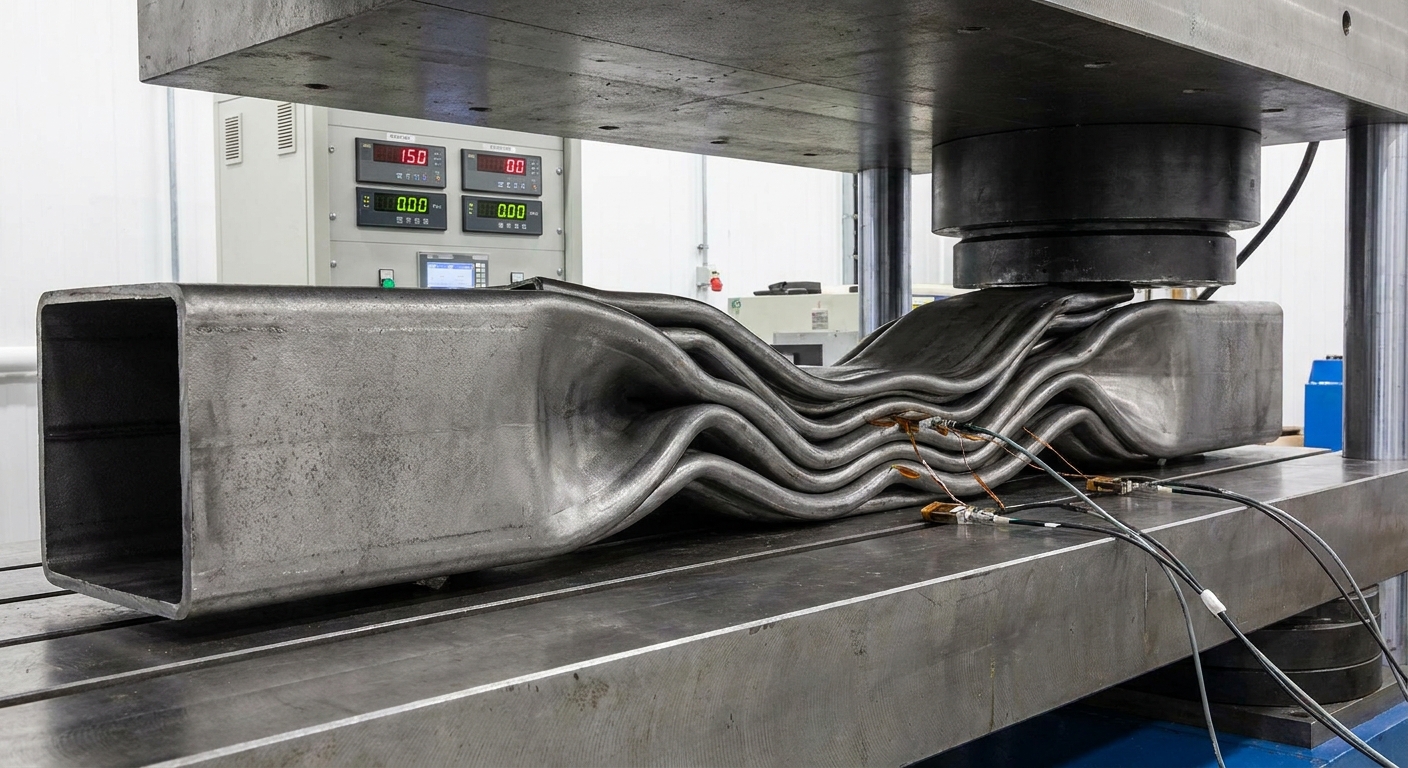
Modern commercial bumpers manage heavy impacts by utilizing specialized crumple channels and high-strength alloys that bend progressively rather than fracturing catastrophically. The mechanics of truck bumper load distribution depend on a calculated chain reaction of progressive deformation phases that step down structural stresses. This physical engineering ensures that extreme crash energy is transformed into thermal and mechanical work within the bumper assembly itself.
When you install a professionally designed guard, you are placing a mechanical shock-absorber in front of your truck’s chassis. The bumper body acts as the initial sacrificial barrier, absorbing low-level forces entirely. During high-speed accidents, the system collapses in a controlled, predictable sequence to preserve the integrity of your tractor.
Energy Dissipation and Material Deformation
To control an impact, a bumper must act as a kinetic sponge through controlled material deformation. When an obstacle strikes your front end, the metal transitions from its elastic limit into its plastic deformation zone.
Let’s look at the science:
By forcing the steel or aluminum to fold and compress at specific points, you convert the kinetic energy of a moving truck into harmless deformation work.
- Elastic Compression: The initial phase where the material flexes and returns to its original shape.
- Plastic Flow: The critical phase where the bumper permanently bends to absorb massive energy spikes.
- Thermal Energy Conversion: The physical process of turning motion into heat as metal crystalline structures shift under load.
How Do High-Strength Metals Behave Under Tension?
Different metals provide vastly different protection profiles when subjected to extreme compressive and tensile stresses. You need a material that offers high ultimate tensile strength but retains enough ductility to bend without cracking.
But wait, there is more:
Brittle metals will snap under heavy impact, sending fragments into your engine bay and offering zero secondary protection. Advanced high-strength alloys stretch and fold, keeping the structural shield intact through multiple impact waves.
- Yield Strength Limits: The point at which a bumper alloy begins to bend permanently to absorb force.
- Ultimate Tensile Capacity: The maximum stress the metal can handle before experiencing structural tearing.
- Ductile-to-Brittle Transition: Choosing alloys that remain ductile and resilient even in sub-zero winter operations.
Key Takeaway: Choosing materials that maximize their plastic deformation capacity without micro-cracking is the single most effective way to dissipate massive impact energy forces.
| Material Designation | Yield Strength (MPa) | Ultimate Tensile Strength (MPa) | Elongation at Break (%) |
|---|---|---|---|
| Structural Mild Steel | 250 MPa | 400 MPa | 25% |
| High-Strength Low-Alloy (HSLA) | 550 MPa | 700 MPa | 18% |
| Structural Aluminum (6061-T6) | 276 MPa | 310 MPa | 12% |
For high-frequency impact applications, HSLA steel offers the optimal balance of ultimate tensile limits and progressive elongation profile.
Does truck bumper load distribution rely on structural steel?
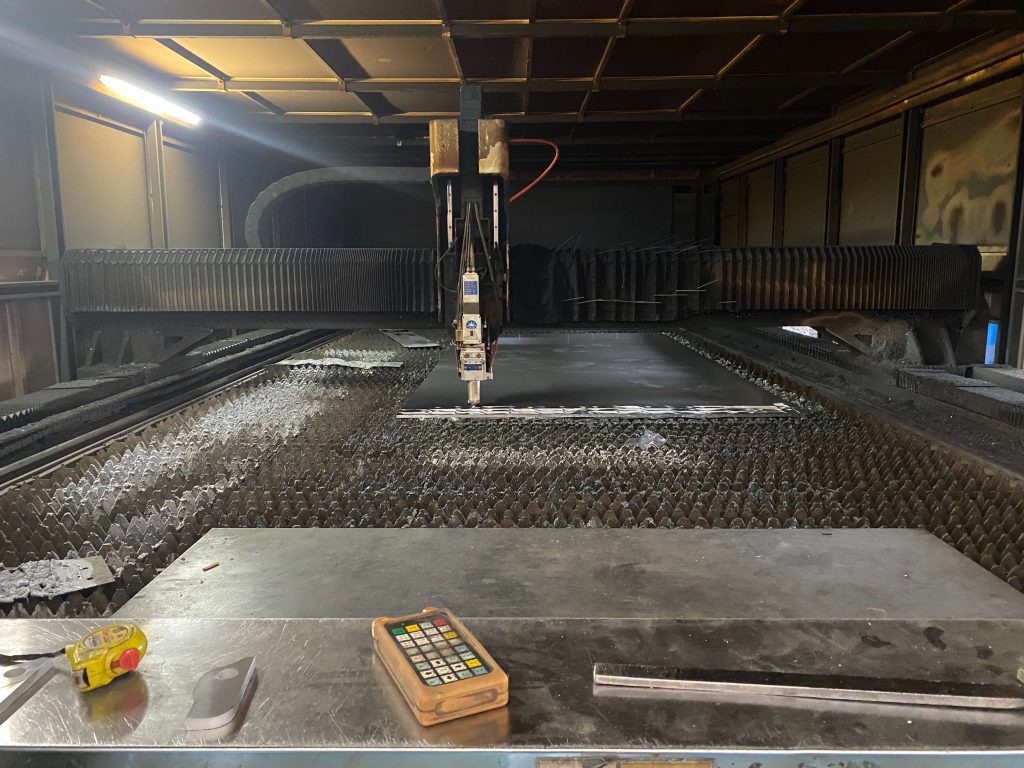
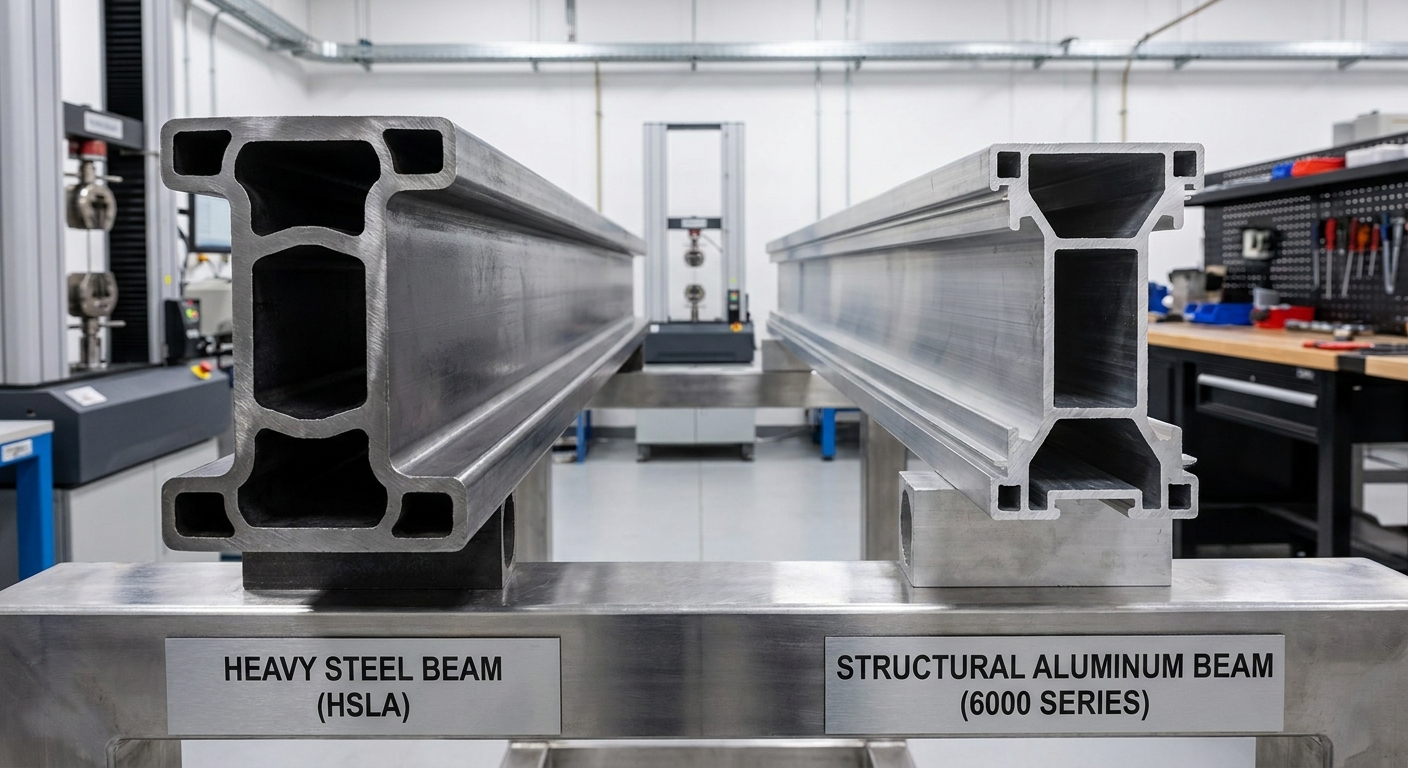
Heavy-gauge structural steel is the industry benchmark for impact distribution, but advanced structural aluminum is also highly viable when optimized with interior webbed reinforcements. Achieving consistent and robust truck bumper load distribution under severe loading conditions demands premium materials manufactured to precise thickness tolerances. Your material selection dictates your fleet’s fuel economy, payload capacity, and long-term repair cycles.
High-strength low-alloy (HSLA) steel provides unmatched resistance to tearing and cracking, making it perfect for extreme off-road or logging applications. However, modern structural aluminum bumpers offer an incredible strength-to-weight ratio for long-haul carriers. By engineering internal gussets and structural channels, aluminum assemblies can match the impact performance of steel while saving hundreds of pounds of dead weight.
High-Strength Steel vs. Lightweight Aluminum
When choosing between steel and aluminum protection, you must balance maximum defensive strength against operational efficiency. Your decision should align directly with your typical route profiles and cargo weight limits.
Here is the trade-off:
Heavy steel guards offer maximum durability against large animal strikes, but their weight can impact your steer axle tire wear and fuel economy.
- Steel Durability: Exceptional resistance to repeated impacts and highly weldable for quick field repairs.
- Aluminum Weight Savings: Lowers your front-axle load, allowing you to maximize legal freight capacity.
- Corrosion Resistance: Structural aluminum naturally resists road salt and moisture, eliminating rust issues.
Custom OEM Fabrications and Thickness Tolerances
To ensure predictable structural behavior under crash conditions, your bumper must be manufactured under strict quality standards. Precision computerized cutting and robotic welding maintain a consistent wall thickness across the entire assembly.
Here is the deal:
A variation of just half a millimeter in plate thickness can cause a bumper to buckle prematurely, failing to distribute the impact load across both chassis rails.
- CNC Laser Cutting: Ensures perfectly straight edges and precise hole patterns to eliminate stress concentrations.
- AWS-Certified Welding: Multi-pass robotic welds guarantee that joints will not split under extreme compressive loads.
- Guaranteed Thickness Tolerances: Maintaining strict material specs so your crash models behave exactly like real-world events.
Key Takeaway: Precision manufacturing with tight tolerance limits is critical; even a minor 1mm variance in plate thickness can cause unpredictable buckling under sudden axial impact loads.
| Material Option | Structural Gauge (mm) | Total Assembly Weight (kg) | Maximum Impact Resistance |
|---|---|---|---|
| Heavy-Gauge HSLA Steel | 5.0 mm | 115 kg | Exceptionally High |
| Reinforced Premium Aluminum | 6.3 mm | 58 kg | Medium-High |
| Standard Commercial Grade | 3.0 mm | 85 kg | Low-Medium |
Choose heavy-gauge HSLA steel for heavy-duty logging and off-road environments, while selecting reinforced premium aluminum for long-haul highway applications where weight optimization is paramount.
How does truck bumper load distribution protect commercial cabs?
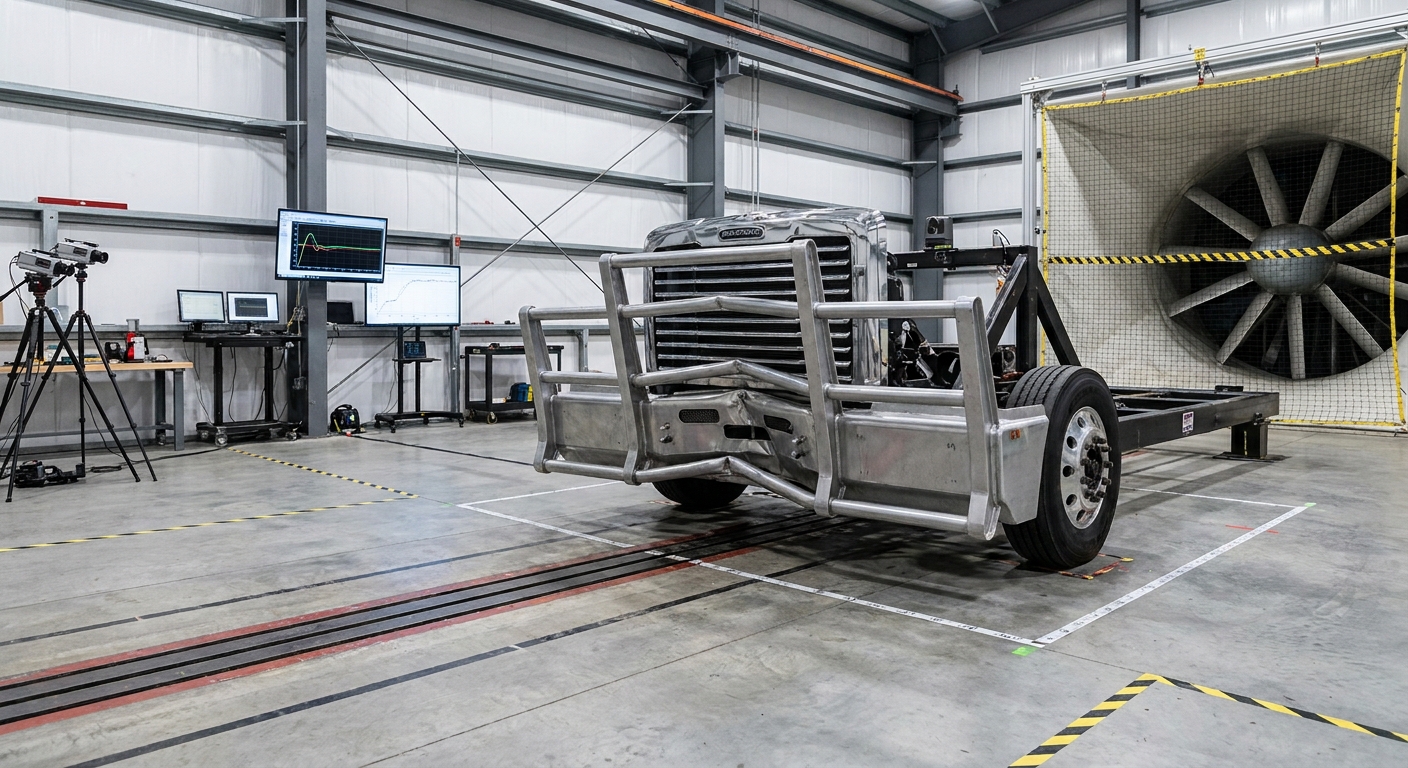
Commercial front-end systems protect cabs by routing kinetic forces downward and outward into the frame rails, away from the passenger compartment. Strategically designed truck bumper load distribution structures prevent localized impacts from pushing backward into the engine’s cooling stack and radiator core. This physical isolation ensures that minor road incidents do not cascade into catastrophic mechanical failures.
Your engine’s cooling pack sits directly behind the factory bumper, making it extremely vulnerable to debris and wildlife impacts. If a collision pushes the bumper face into your radiator, your truck will immediately dump its coolant and overheat. An engineered guard maintains a rigid safety clearance zone, ensuring your vital mechanical components remain fully untouched.
Directing Kinetic Energy Away from the Cab
To protect your truck’s cab, you must control the path that impact energy takes through the vehicle’s structure. High-performance bumper guards use structural cross-members to bridge the gap between your truck’s frame rails.
Think about it this way:
By turning a single point-impact into a dual-rail distributed load, you reduce the structural strain on any single mounting point by half.
- Load Bridging: Directing central impact forces outward toward the high-strength chassis rails.
- Debris Deflection: Angling the bumper face to guide road obstacles downward and away from your tires.
- Chassis Alignment Protection: Preventing the left or right frame rail from twisting independently during offset impacts.
Role of Grille Guards in Deflecting Animal Impacts
Heavy-duty grille guards act as structural sails, distributing localized animal strikes across multiple heavy-duty attachment points. When you hit a large deer or moose, the animal’s body can easily bypass a low bumper and crash through your grille.
Let’s dive in:
A multi-post high-rise grille guard catches the impact and uses its structural frame to redirect the force downward.
- Moose-Grade Vertical Posts: Heavy-walled structural tubing designed to resist high-elevation wildlife impacts.
- Headlight Protection Loops: Wrap-around bars that shield expensive LED headlight modules from flying debris.
- Sacrificial Structural Tabs: Built-in flex points that absorb minor vibrations without fatiguing the main bracket assembly.
Key Takeaway: Multi-post grille guards act as a broad shield, preventing isolated point-impacts (such as deer or debris strikes) from developing into localized frame twists.
| Component Inspected | Without Guard Deflection (mm) | With Advanced Guard Deflection (mm) | Protection Status |
|---|---|---|---|
| Radiator Core | 140 mm Deflection | 5 mm Deflection | Fully Operational |
| Engine Block Face | 45 mm Deflection | 0 mm Deflection | No Damage |
| Front Steering Assembly | 90 mm Deflection | 8 mm Deflection | Safe |
Installing integrated front guards dramatically reduces component deflection metrics, ensuring the truck can still be driven after a moderate frontal impact.
Can truck bumper load distribution reduce OEM repair costs?
Yes, optimized force distribution prevents expensive structural damage to the vehicle’s frame, reducing simple collisions to quick, bolt-on replacement repairs. By utilizing advanced truck bumper load distribution systems, operators isolate collision forces to sacrificial, bolt-on components, saving the expensive chassis frame. This smart design transforms a potentially write-off-level accident into a minor maintenance task that you can resolve in your own shop.
When a truck suffers frame rail twist, repairing the chassis requires specialized laser straightening equipment and weeks of downtime. In many cases, insurance companies will write off a Class 8 tractor simply due to minor frame warping. By using engineered energy-dissipating bumpers, you can ensure that the dynamic forces never reach the yield threshold of your truck’s main frame.
Minimizing Frame Rail Damage and Twist
Preventing your chassis rails from bending or twisting during an off-center accident is the most effective way to control repair costs. Heavy-duty bumpers utilize robust cross-braces that tie your frame ends together.
Here is the financial reality:
A factory-installed bumper offers zero cross-chassis reinforcement, leaving each frame rail to face impact forces completely alone.
- Structural Cross-Ties: Reinforcing the front of your chassis to prevent independent rail movement.
- Shear Bolt Integration: Using specific grade-8 hardware that deforms under extreme stress before your frame rails can warp.
- Quick-Release Mounts: Allowing your maintenance team to swap out a damaged bumper in under an hour.
Cost-Benefit Analysis of Heavy-Duty Protection
Investing in heavy-duty commercial guards yields an immediate return on investment the moment your truck encounters highway debris. You must evaluate the upfront cost of armor against the massive expense of towing, cargo delays, and mechanical repairs.
Let’s look at the numbers:
A single animal strike with a factory bumper can easily cost your business over fifteen thousand dollars in direct repairs and lost revenue.
- Zero-Downtime Operation: Keeping your truck on its schedule even after a moderate front-end collision.
- Insurance Premium Mitigation: Avoiding costly claims by protecting your vehicles from major structural losses.
- Salvage Value Retention: Keeping your core tractor frame in pristine, unblemished condition.
Key Takeaway: Equipping a commercial vehicle with an advanced, energy-distributing guard reduces average post-accident fleet downtime from 14 days down to less than 24 hours.
| Accident Severity | Standard Factory Bumper Repair Cost | Heavy-Duty Bumper System Repair Cost | Savings Realized |
|---|---|---|---|
| Light Strike (Debris) | \$1,800 + 2 days down | \$0 + 0 days down | \$1,800 (100%) |
| Medium Strike (Deer) | \$12,500 + 8 days down | \$450 (bracket replace) | \$12,050 (96%) |
| Severe Collision | \$45,000 + Frame Twist | \$8,500 (bumper swap) | \$36,500 (81%) |
Fleet managers should view heavy-duty bumpers as a proactive insurance policy that completely eliminates the high financial risks of moderate deer and road debris strikes.
How do crumple zones affect truck bumper load distribution?
Crumple zones control the rate of impact transfer, allowing kinetic energy to be absorbed in stages before reaching the rigid mainframe of the truck. The effectiveness of modern truck bumper load distribution is highly dependent on integrated crumple zones that collapse sequentially under extreme axial loading. By building specific failure points into your bumper, you control exactly how and where the metal folds during a crash.
If your front end is completely rigid and unyielding, the entire shock of a collision will travel instantly through your mounting brackets and into your frame. This sudden, violent energy transfer can snap your engine mounts and destroy your transmission casing. Crumple zones act as mechanical fuses, absorbing the peak impact energy before it can penetrate your vehicle’s core systems.
Engineering Deformable Sections in Heavy Trucks
Creating effective crumple zones in commercial vehicle bumpers requires advanced engineering and precise material layout. Designers use specific notches, cutouts, and pre-formed folds in the internal steel bumper beams to guide the collapse.
It sounds counterintuitive, but:
You are deliberately designing parts of your bumper to buckle and fail under specific, calculated stress levels.
- Pre-Folded Metal Profiles: Guiding the direction of the metal collapse to prevent it from puncturing your radiator.
- Sacrificial Structural Bays: Hollow internal chambers that collapse sequentially to absorb high-velocity impacts.
- Engineered Stress Risers: Small, localized cutouts that initiate the buckling process at exact force thresholds.
Balancing Rigidity with Sacrificial Structures
A high-performance bumper must be rigid enough to handle everyday road vibration and low-speed parking bumps without flexing, yet soft enough to yield during a major crash. Achieving this delicate balance requires multi-stage structural resistance.
Here is the deal:
If your guard is too soft, it will fold during minor parking maneuvers; if it is too stiff, it will damage your truck’s frame in a highway collision.
- Low-Force Elasticity: Resisting wind resistance, minor gravel hits, and standard road vibrations completely.
- Mid-Force Yield Gates: Buckling predictably during deer strikes to absorb the animal’s kinetic energy.
- High-Force Frame Bypass: Channeling extreme collision energy past your radiator and directly into your frame rails.
Key Takeaway: A bumper system must feature designed sacrificial failure points to absorb energy and protect the truck’s rigid main frame rails from bending.
| Deformation Stage | Applied Load Range (kN) | Structural Action | Energy Absorbed (kJ) |
|---|---|---|---|
| Stage 1: Elastic | 0 – 150 kN | Flex and Recovery | 15 kJ |
| Stage 2: Controlled Buckle | 150 – 450 kN | Sacrificial Bracket Collapse | 120 kJ |
| Stage 3: Rigid Bypass | > 450 kN | Force Transferred to Frame | Remaining Force |
Ensure mounting bracket hardware is rated specifically to shear or buckle before the yield point of the primary truck frame is reached.
Why does truck bumper load distribution need mounting brackets?
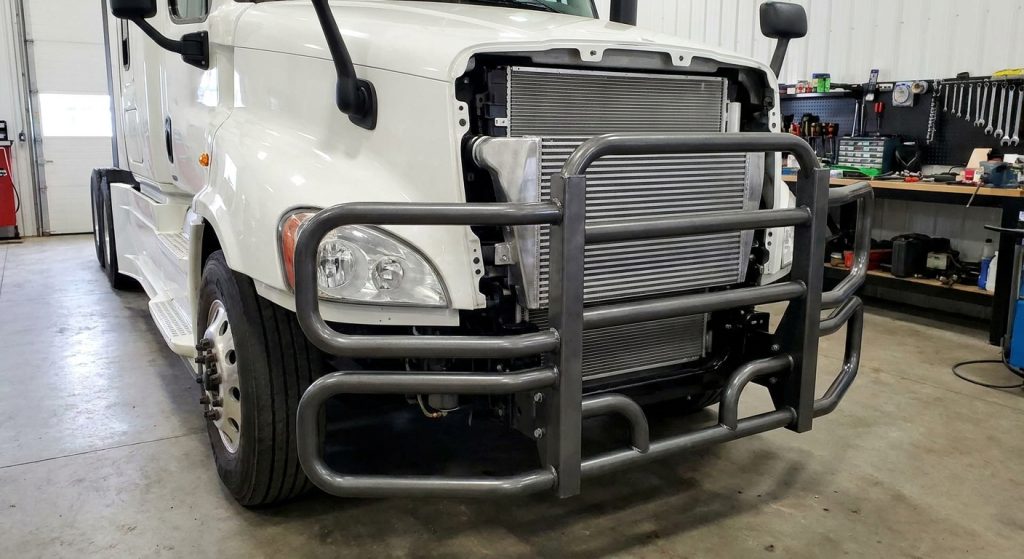
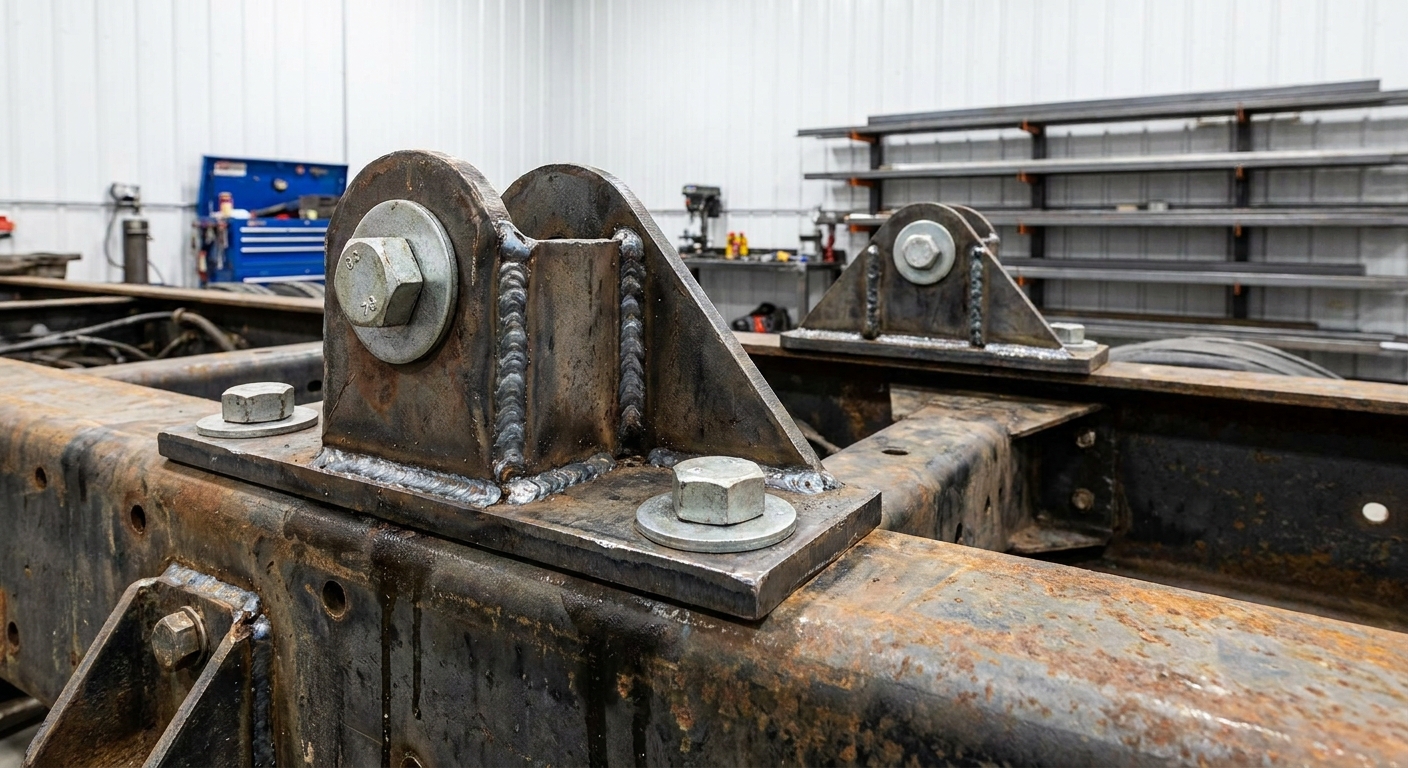
Mounting brackets serve as structural shear-keys, acting as the critical mechanical fuse between the bumper face and the vehicle frame. Secure, well-engineered mounting assemblies ensure that truck bumper load distribution forces are guided evenly into the center of both frame rails, preventing asymmetrical loading. Without these precision brackets, your bumper cannot transfer impact forces safely to your truck’s chassis.
Your mounting brackets must handle extreme vertical, horizontal, and torsional stresses during daily operations. During a crash, they must slide, shear, or buckle in a highly controlled manner to prevent localized frame rail damage. By using specialized grade-8 structural bolts and designed mechanical slip-slots, these brackets manage the ultimate interface between your armor and your truck.
Shear Pins and Energy-Absorbing Brackets
Advanced mounting systems use specialized fasteners and sliding brackets that act as heavy-duty shock-absorbers during a front-end crash. When the impact force exceeds a safe threshold, these brackets allow the bumper to shift slightly.
This is where the magic happens:
By allowing a controlled mechanical movement of just two inches, you can dissipate thousands of foot-pounds of raw kinetic energy.
- Grade-8 Fasteners: High-tensile steel bolts that resist premature shearing under daily operating loads.
- Slotted Mounting Channels: Allowing the bumper to slide backward progressively to absorb high-velocity impacts.
- Energy-Absorbing Inserts: Sacrificial polyurethane or soft metal inserts that compress under extreme force.
Preventing Severe Chassis Frame Alignment Shifts
An off-center crash is one of the most dangerous scenarios for your truck’s chassis, as it concentrates all the force onto a single frame rail. If your mounting brackets are too rigid, they will bend that single rail inward, ruining your truck’s alignment permanently.
Think about it:
By using an energy-distributing mounting bracket, you force both chassis rails to share the load, keeping your frame straight and true.
- Asymmetric Load Balancing: Transferring forces from an angled hit across both frame mounting plates.
- Vertical Stress Isolation: Preventing the bumper from twisting upward and crushing your hood during a low-angle impact.
- Replaceable Wear Plates: Sacrificial steel plates that protect your factory frame flanges from direct metal-on-metal friction.
Key Takeaway: The mounting bracket is the structural gatekeeper; if it lacks sufficient shear capacity, it will transfer off-center crash forces into a single frame rail, causing catastrophic frame twist.
| Bracket Bolt Grade | Tensile Strength (psi) | Recommended Torque (lb-ft) | Shear Load Limit (lbs) |
|---|---|---|---|
| Grade 5 Carbon Steel | 120,000 psi | 110 lb-ft | 18,500 lbs |
| Grade 8 Alloy Steel | 150,000 psi | 150 lb-ft | 24,000 lbs |
| Custom Shear Assembly | Spec Custom | 135 lb-ft | 14,500 lbs (Shear Target) |
Always use designated high-strength shear assemblies supplied by the specialized bumper manufacturer to ensure predictable breakaway release thresholds.
Does truck bumper load distribution shift during moose impacts?
Yes, high-mass animal strikes generate elevated point-loads that pivot backward and upward, requiring wide-profile structural frameworks to control the energy transfer. To safely manage these high-mass strikes, truck bumper load distribution structures must feature dense vertical tubing layouts to catch and redirect the animal downward. This specialized design is crucial for trucks operating on northern transport routes where wildlife hazards are a daily reality.
A moose impact is uniquely dangerous because of the animal’s high center of gravity and massive weight. When a truck strikes a moose, its long legs break instantly, causing the heavy torso to roll directly over the hood and crash into your windshield. Standard highway bumpers offer zero protection against this high-level impact zone, leaving your driver completely vulnerable in the cab.
High-Mass Wildlife Collision Dynamics
A moose collision is not a simple front-end tap; it is a violent, multi-stage event that can easily crush your tractor’s entire cab structure. The initial impact occurs at your grille level, but the secondary impact happens as the animal’s mass rolls upward.
This is a worst-case scenario:
Without a high-rise vertical guard, a 1,200-pound animal will bypass your bumper entirely and enter your cabin through the glass.
- High-Level Pivot Points: Designing structural cross-bars at hood level to stop the upward roll of high-mass wildlife.
- Multi-Post Deflection Systems: Using four main vertical posts to capture and hold the animal’s torso on the guard.
- Energy-Routing Struts: Angle braces that transfer high-elevation impact forces down to your frame rails.
How Do Moose Bumpers Deflect Multi-Point Loading?
To handle the unpredictable physics of a wildlife strike, your bumper must protect your entire front end, including your headlights and fenders. Heavy-duty moose guards feature wrap-around outer bars that match your truck’s aerodynamic profile.
But wait, there is more:
By curving the guard’s outer wings backward, you can deflect the animal’s body outward and away from your front tires, preserving your steering control.
- Aerodynamic Curvature: Sleek profiles that minimize wind drag while maximizing side-impact deflection.
- Boxing Section Guards: Reinforced internal channels that keep the outer wings from bending back into your fiberglass fenders.
- Integrated Sub-Frames: Heavy-duty steel under-structures that reinforce your factory bumper’s mounting points.
Key Takeaway: Moose bumpers must feature a robust 4-post design to resist the massive twisting forces and upward pivot characteristic of heavy wildlife strikes.
| Bumper Type Installed | Center-of-Gravity Impact Target | Hood/Windshield Intrusion | Driving Post-Impact |
|---|---|---|---|
| Standard 2-Post Guard | High (Windshield Level) | Severe Intrusion | No (Towed) |
| Premium 4-Post Moose Guard | Low-Medium (Deflected) | Zero Intrusion | Yes (Driven Away) |
Fleets operating on northern commercial routes must transition to 4-post structural steel assemblies to reliably mitigate the unique rotational dynamics of moose impacts.
How do we test truck bumper load distribution under pressure?
Bumper stress distribution is validated using advanced finite element analysis (FEA) simulations followed by physical crash barrier test drops. Rigorous stress validation verifies that truck bumper load distribution performance meets real-world safety expectations and strict fleet durability standards. This dual-stage validation process ensures that your safety investment will perform flawlessly when you need it most.
Before a physical prototype is ever manufactured, engineers use advanced computer programs to simulate different crash scenarios. We can model head-on impacts, offset crashes, and wildlife strikes at various speeds and angles. This digital testing allows us to identify potential weak points, optimize material thickness, and refine our bracket geometries before cutting any metal.
Computer-Aided Finite Element Analysis (FEA)
Finite element analysis is the modern cornerstone of commercial safety design, allowing us to see inside the metal during a high-speed collision. The software maps stress concentrations, strain distributions, and material deformation in vivid detail.
What does this data show?
It tells us exactly where the bumper will yield, how much energy it will absorb, and how much force it will transmit to your frame rails.
- Stress-Vector Mapping: Visualizing the paths that force takes as it travels through your bumper assembly.
- Strain Propagation Graphs: Measuring how much the material stretches and deforms under dynamic pressure.
- Thickness Optimization Models: Refining our designs to place strength only where it is needed, keeping the bumper light and efficient.
Physical Crash Testing and Regulatory Compliance
While computer simulations are incredibly powerful, they must be validated through physical, real-world destructive testing. Engineers place prototype bumpers on specialized test rigs and subject them to extreme impact forces.
Let’s dive in:
By dropping heavy weights or launching physical barriers at our bumpers, we ensure that our real-world manufacturing matches our digital models.
- Dynamic Pendulum Drops: Striking the bumper face with a heavy steel pendulum to simulate real-world traffic collisions.
- Offset Barrier Impacts: Testing the guard’s resistance to off-center crashes that threaten to twist your frame rails.
- Weld Integrity Analysis: Inspecting welded joints under microscopic scanners after a crash to verify they did not crack.
Key Takeaway: Virtual FEA modeling must be physically validated by controlled destructive testing to ensure real-world metal formulations behave exactly as simulated.
| Structural Parameter Evaluated | FEA Computer Simulation | Physical Crash Test | Variance Registered |
|---|---|---|---|
| First Yield Point (kN) | 280 kN | 285 kN | +1.78% |
| Maximum Deflection Depth | 42 mm | 44 mm | +4.76% |
| Bracket Shearing Point | 510 kN | 495 kN | -2.94% |
A variance of under 5% between virtual simulations and physical testing verifies the high accuracy of the engineering design and manufacturing quality controls.
Is truck bumper load distribution improved by modern design?
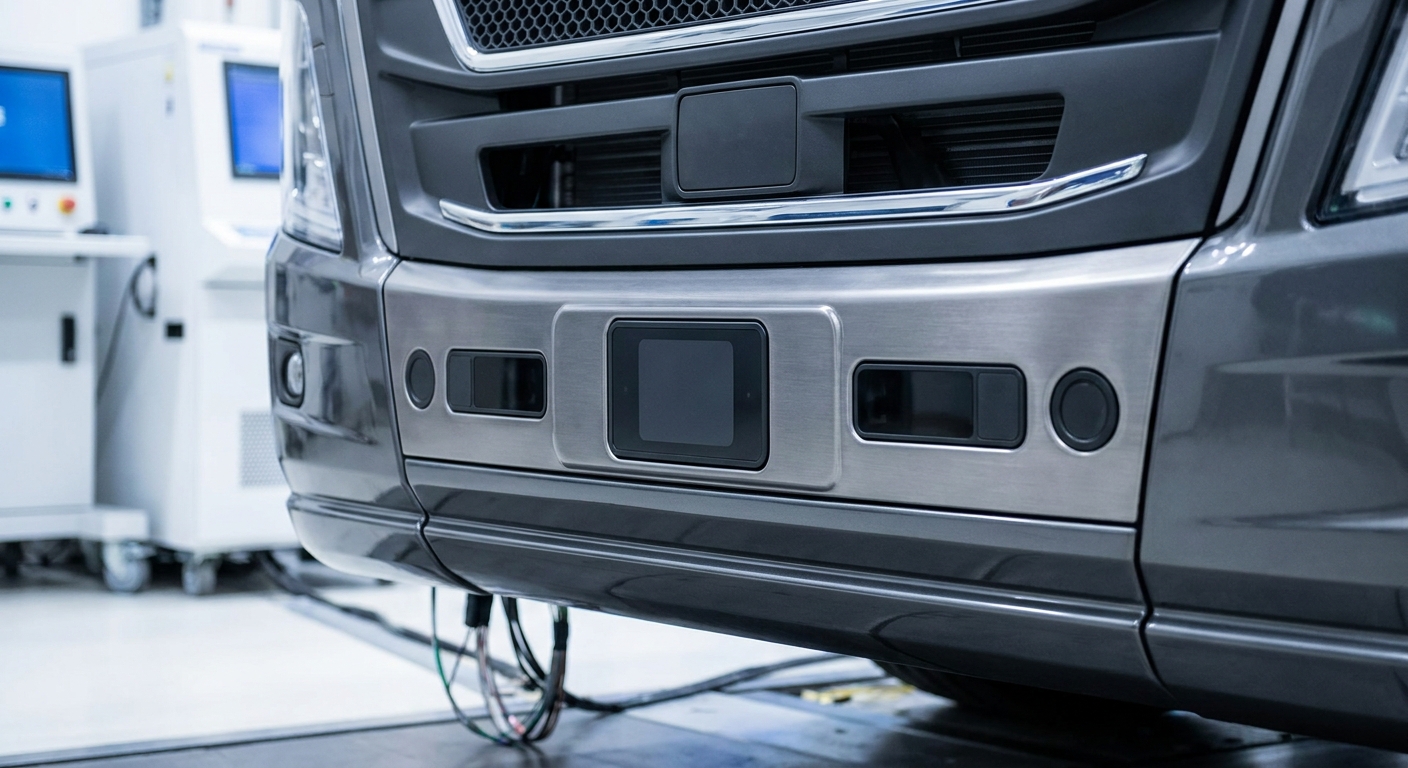
Yes, modern design improves force management by incorporating advanced metallurgy, multi-layer composite structures, and aerodynamic geometry. The future of truck bumper load distribution is evolving, integrating active collision-mitigation sensors directly behind protective structural alloys. This seamless blending of physical armor and digital safety is changing the face of commercial fleet operations.
Older commercial bumpers were simply heavy, rigid pieces of channel iron bolted directly to your frame rails. While they were strong, they offered zero energy absorption, transferring the entire shock of any impact directly to your driver and tractor. Modern designs use sophisticated materials and aerodynamic styling to deliver superior protection while actually improving your truck’s fuel economy.
Smart Materials and Shape Memory Alloys
The next generation of fleet protection is utilizing advanced composites and smart metals that alter their physical properties during a crash. These innovative materials are designed to optimize their stiffness dynamically depending on the speed of the impact.
This is the cutting edge:
By incorporating energy-absorbing polymers and shape-recovery metals, future bumpers will be able to survive moderate strikes without retaining any permanent damage.
- Non-Newtonian Fluid Dampers: Shock-absorption chambers that stiffen instantly when struck by high-speed objects.
- Shape Memory Alloys: Advanced metals that can return to their original pre-crash shape after being heated.
- Carbon Fiber Hybrid Composites: Ultra-lightweight structures that deliver incredible rigidity with a fraction of the weight of steel.
Future Trends in Commercial Fleet Safety Design
As commercial vehicles become more advanced, your front-end protection must adapt to house complex electronic safety systems. Modern Class 8 trucks are equipped with advanced driver assistance systems (ADAS), including radar units and collision-mitigation sensors.
But wait, there is more:
If your heavy-duty guard blocks these sensors, your truck’s emergency braking and adaptive cruise control will fail to operate. Modern bumpers are engineered with protective, radar-compliant chambers that shield these vital sensors without blocking their signals.
- ADAS Integration Chambers: Molded housings that protect expensive radar and camera modules from road debris.
- Sensing Window Materials: Using specialized, signal-transparent polycarbonates that allow radar waves to pass through freely.
- Vibration-Isolation Mounts: Protecting delicate electronic sensors from the continuous vibration of highway driving.
Key Takeaway: Modern bumpers must serve dual roles, providing robust physical shielding while keeping integrated ADAS sensors clean, aligned, and functional.
| Design Era | Primary Material Base | Sensor Integration | Impact Capacity Rating |
|---|---|---|---|
| Legacy (1980 – 2000) | Single-Layer Rigid Steel | None | Low-Medium (Rigid Shock) |
| Modern (2000 – 2020) | Multi-Layer HSLA + Alum | External Sensor Mounts | High (Progressive Buckle) |
| Future (2020 & Beyond) | Smart Composites + Alloys | Integrated ADAS Shielding | Exceptionally High |
Upgrading to modern bumpers with integrated sensor mounting solutions prevents constant ADAS recalibration errors after minor road vibrations.
Conclusion
Protecting your transport assets from unexpected highway collisions requires an engineering-first approach to front-end armor. Standard factory bumpers treat wildlife strikes and road hazards as trivial cosmetic incidents, leaving your cooling packs, chassis rails, and engine blocks open to severe structural damage. By upgrading your fleet to advanced, energy-dissipating armor, you ensure that even extreme collision forces are managed through a controlled, multi-stage process of progressive deformation and strategic force dispersion. At Brontec Trailer, we combine AWS-certified welding precision with field-tested engineering to build the market’s toughest heavy-duty Class 8 protection equipment. We design protection systems that safeguard your drivers, shield your cooling packs, and eliminate costly vehicle downtime. To safeguard your commercial vehicles from costly collision damage and minimize fleet downtime, contact us today to design a tailored heavy-duty bumper package for your transport fleet.
Frequently Asked Questions
Can I install a heavy-duty bumper without affecting my truck’s ADAS sensors?
Yes, you can. Modern heavy-duty bumpers are engineered with specialized radar-compliant windows and protective mounting chambers designed to house your OEM sensors securely, ensuring your collision-mitigation systems function exactly as intended without any calibration errors.
What’s the best material for a heavy-duty fleet bumper?
HSLA steel is the premier option. High-strength low-alloy steel provides the ultimate balance of tensile strength and progressive elongation, making it the most durable choice for severe-duty fleets, while reinforced aluminum remains the best option for weight-sensitive long-haul applications.
How do I know if my mounting brackets are designed to absorb impact?
You should look for integrated shear points. Engineered brackets feature distinct mechanical slip-slots, pre-folded buckling notches, or calibrated shear pins that allow controlled movement during a severe crash, preventing the impact energy from transferring straight into your frame rails.
Can a properly designed bumper prevent frame rail twist during an off-center crash?
Absolutely. High-quality bumpers are built with structural internal cross-members that bridge your chassis ends, transforming a single-point asymmetric strike into a balanced, dual-rail distributed load that keeps your main frame rails straight.
Will upgrading to a heavy-duty guard increase my steer axle tire wear?
No, it will not. By selecting reinforced aluminum moose bumpers or lightweight high-strength steel designs, you can add maximum front-end armor to your truck while keeping your axle weights well within optimal operating limits, preserving your steering geometry and tire life.