
In welding, “stacking dimes” describes a weld bead with a series of uniform, overlapping ripples that resemble stacked coins. This distinctive stacked dime weld appearance is commonly associated with controlled TIG welding, where consistent travel speed, heat input, torch movement, and filler-metal addition help produce an even bead pattern. In heavy-duty fabrication, including truck bumpers, trailers, and aluminum components, clean and consistent welds can reflect careful workmanship and process control. However, appearance alone does not determine weld quality—proper fusion, penetration, joint preparation, and defect control are what ultimately determine structural performance.
What is a stacked dime weld?
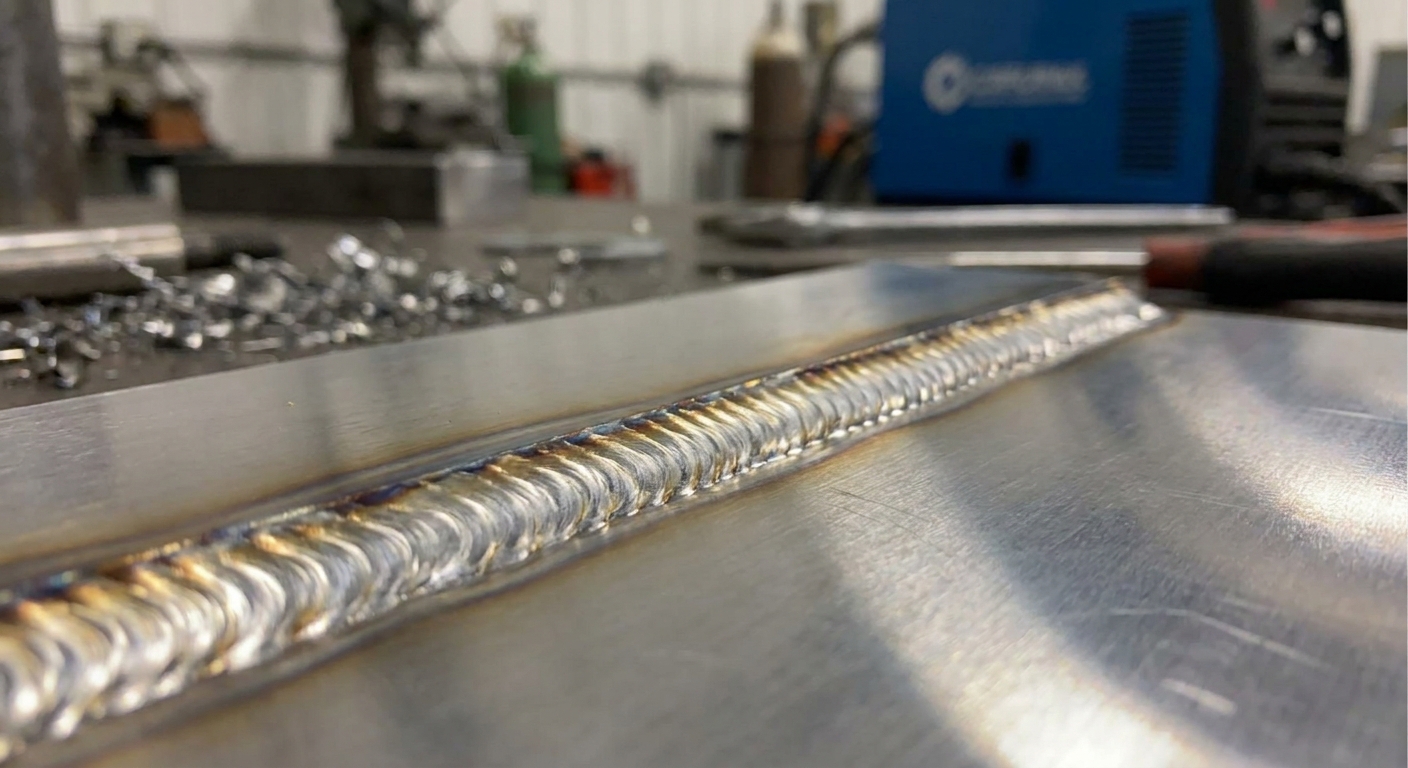
A stacked dime weld is a professional-grade weld profile characterized by evenly spaced, crescent-shaped ripples along the weld face. This specific shape indicates that the welder maintained absolute consistency in torch movement and filler metal application. Achieving this look requires rigorous training and hours of hands-on practice.
Why do fabricators strive for this aesthetic?
When you look at high-end custom metal fabrications, a beautiful weld bead immediately signals quality and attention to detail. Think about it: a client paying premium rates for custom-made trailers expects every component on their aluminum trailers to look flawless and perform reliably under extreme road conditions.
If you want to impress customers and pass structural inspections, adopting this method is your best bet. Here is the kicker: consistent visual ripples are highly associated with professional-grade workmanship across multiple industrial sectors.
- Overlap spacing: 1.5mm to 3mm
- Surface texture: Smooth, uniform ripples
- Spatter levels: Zero to minimal
Key Takeaway: Mastering this bead profile enhances your brand’s reputation for premium craftsmanship and increases the market value of your custom-built trailers.
| Metric | Requirement |
|---|---|
| Ideal Width | Consistent with joint thickness |
| Bead Contour | Flat to slightly convex |
A visually flawless bead contour ensures even stress distribution across the entire joint area.
Why does a stacked dime weld look so uniform?
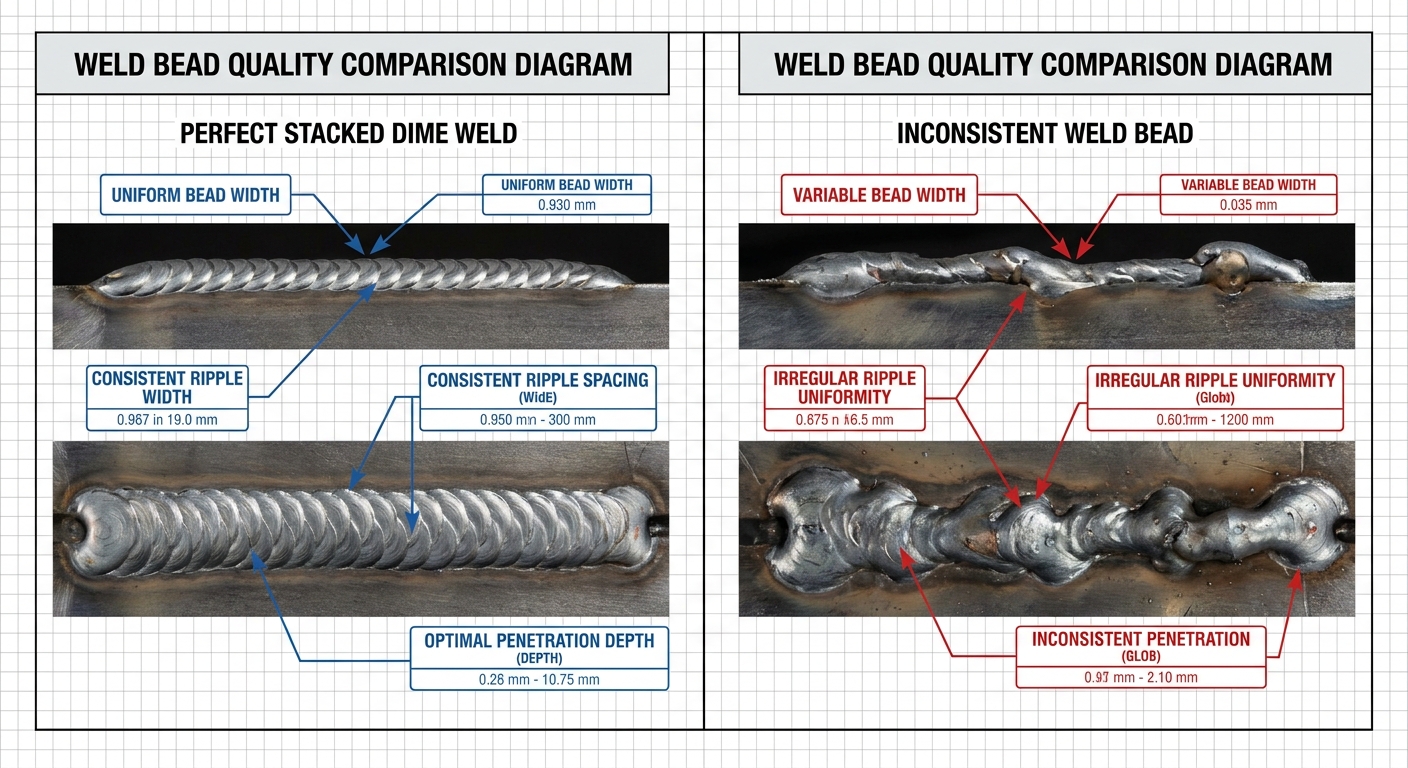
A stacked dime weld looks uniform because the welder maintains a highly consistent travel speed and precise filler rod dipping intervals. When these two variables are locked in, each subsequent ripple overlaps the previous one at an identical distance. This rhythmic motion creates a highly structured pattern that stands out instantly.
How does rhythm affect the weld puddle?
Your weld puddle reacts instantly to changes in heat input, torch movement, and filler metal cooling effects. But that’s not all; if you hesitate for even a fraction of a second, the weld pool expands rapidly and destroys the uniform shape of your stack.
To prevent this issue, you must synchronize your hands to work in perfect harmony.
- Step forward: Advance the torch at a steady 1/16-inch increment.
- Pause briefly: Allow the heat to establish the puddle diameter.
- Add filler: Dab the rod into the puddle’s leading edge.
Key Takeaway: Focusing on a steady physical rhythm stabilizes the weld puddle size and ensures a clean, uniform outer bead shape.
| Action | Puddle Impact |
|---|---|
| Precise Dabbing | Uniform ripple height |
| Constant Travel | Even spacing |
Maintaining a steady dipping cadence prevents localized heat accumulation and preserves the coin-like overlapping pattern.
Which processes create a stacked dime weld?
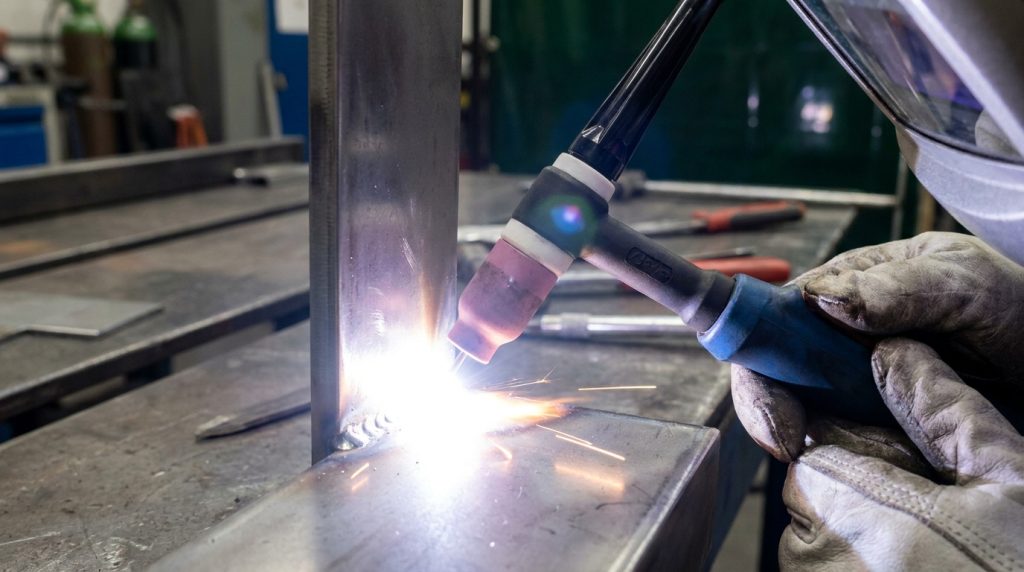
The stacked dime weld is most easily produced using Gas Tungsten Arc Welding (TIG), though skilled operators can replicate it with other processes. TIG provides independent control over the heat source and filler rod feeding, which is perfect for laying down clean, coin-like ripples.
Is TIG the only way to get this look?
While TIG is the absolute gold standard for clean visual profiles, you can also manipulate other machines to mimic this aesthetic. Think about it: a skilled operator can whip a stick electrode or weave a MIG gun to leave a highly similar rippled pattern along a joint.
However, forcing a specific cosmetic look onto a process not designed for it can lead to structural integrity issues.
- TIG: Naturally smooth, highly controlled ripples.
- MIG: Requires continuous weaving or whipping techniques.
- Stick: Achieved using fast-freeze electrodes.
Key Takeaway: Using TIG welding guarantees the most pristine aesthetic results without risking cold lap or lack of root fusion.
| Process | Visual Control | Risk of Defects |
|---|---|---|
| TIG (GTAW) | Excellent | Low (With skill) |
| MIG (GMAW) | Moderate | High (Whip technique) |
Choosing TIG welding for visible joints guarantees maximum aesthetic appeal and structural safety.
How do you start a TIG stacked dime weld?
You start a TIG stacked dime weld by establishing a clean, controlled weld puddle on your base metal before introducing any filler wire. Once the puddle is about 1/4-inch wide, you begin your rhythmic cycle of stepping the torch forward and dabbing the rod. This foundational step ensures that your very first “dime” fuses perfectly with both plates.
What is the ideal torch positioning?
To get the best results, you must maintain a consistent push angle of 10 to 15 degrees. Here’s the kicker: if your torch angle becomes too steep, you will lose control of the shielding gas coverage and risk contaminating your tungsten electrode.
Keep your arc length short and your movements deliberate to prevent the arc from wandering.
- Arc length: Keep it within 1/16 to 3/32 of an inch.
- Torch direction: Always push the puddle to ensure preheating.
- Electrode prep: Grind the tungsten to a sharp point with a flat tip.
Key Takeaway: Setting the correct torch angle and arc length from the first second prevents puddle instability and weld contamination.
| Parameter | Setting |
|---|---|
| Torch Angle | 10 – 15 degrees push |
| Gas Coverage | Laminar flow gas lens |
Utilizing a high-quality gas lens stabilizes your arc column and prevents oxidation during the start of your weld run.
Is a stacked dime weld structurally stronger?
No, a stacked dime weld is not inherently stronger than a smooth, flat bead unless it achieves complete penetration at the root of the joint. In fact, heavy ripples can sometimes act as minor stress concentrators under extreme vibrational or cyclical loads. For structural applications, internal weld quality always supersedes surface appearance.
What are the risks of prioritizing looks?
If you focus solely on creating a beautiful pattern, you might end up neglecting actual root penetration. Think about it: a gorgeous weld that only sits on the surface of the metal will crack and fail catastrophically under heavy highway cargo loads.
Many amateur builders make this mistake when welding custom trailers or fleet bodies.
- Cold lap: Metal flows over the edge without fusing to the base plate.
- Lack of fusion: The weld metal fails to bond with the base plate internally.
- Undercutting: High heat burns away the base metal edges without adding reinforcement.
Key Takeaway: Prioritizing complete root fusion over superficial beauty guarantees that your structural components will withstand extreme road abuse.
| Attribute | Aesthetic Weld | Structural Weld |
|---|---|---|
| Focus | Surface pattern | Deep root fusion |
| Main Risk | Cold lap defects | Over-penetration |
Ensure your welding technique balances surface cosmetic ripples with deep, complete joint penetration.
Can MIG machines make a stacked dime weld?
Yes, a MIG machine can produce a stacked dime weld pattern, but it requires highly specialized torch manipulation to avoid dangerous structural defects. The most common continuous-arc method involves a rapid “whip and pause” motion along the joint line. This technique creates overlapping semicircles without extinguishing the welding arc.
Why is trigger-tacking highly discouraged?
Many amateur builders use the “trigger-tacking” method, where you pull and release the gun trigger repeatedly to create spot welds. But that’s not all; this process creates a cold start at every single point, leading to extremely weak joints.
If you want to weld structural components safely, you must maintain a continuous arc at all times.
- Continuous arc: Keeps the weld metal hot and fully fluid.
- Whip and pause: Pushes forward to penetrate, pauses to build up height.
- Cursive e loop: Creates uniform circular overlapping ripples continuously.
Key Takeaway: Using a continuous-arc weaving technique allows you to achieve the desired rippled look while maintaining full structural safety.
| Method | Joint Strength | Visual Appeal |
|---|---|---|
| Trigger-Tacking | Very Low (Dangerous) | High |
| Whip and Pause | High | Moderate to High |
Avoid trigger-tacking on any structural trailer parts to prevent catastrophic failure on the highway.
What settings help make a stacked dime weld?
To achieve a consistent stacked dime weld, you need to configure your machine’s amperage, pulse frequency, and gas flow rates correctly. Adjusting these settings establishes a highly stable electric arc that responds predictably to your physical hand movements. Modern inverter machines feature advanced pulse settings that can mechanically assist in forming uniform ripples.
How does pulse frequency assist your technique?
Setting your welding machine to pulse mode allows you to establish a regular cooling and heating cycle. Think about it: when the machine pulses to high amperage, it melts the metal, and when it drops to low amperage, the puddle freezes instantly into a perfect ripple.
This automatic cycling takes a massive amount of physical strain off your hands. Or, you can reach out directly via our contact us form if you need support setting up your line.
- Pulse frequency: Set between 1 and 2 Hz for manual timing.
- Background current: Keep at 30% to 50% of peak amperage.
- Peak time: Adjust to 40% or 50% to control heat input.
Key Takeaway: Leveraging your machine’s built-in pulse controls simplifies the process of creating highly uniform, professional-grade ripples.
| Parameter | Steel Setting | Aluminum Setting |
|---|---|---|
| Amperage | ~1 amp per 0.001″ | ~1.2 amps per 0.001″ |
| Shielding Gas | 100% Argon | 100% Argon |
Fine-tuning your inverter’s pulse frequency allows you to establish a reliable physical tempo during long welding runs.
How do you inspect a stacked dime weld?

You inspect a stacked dime weld by evaluating both its surface profile symmetry and its internal metallurgical soundness. A visually perfect bead can still fail inspection if it contains micro-cracks, surface porosity, or incomplete tie-ins. Professional quality control programs utilize a combination of visual, dimensional, and non-destructive testing to verify joint integrity.
What tools do inspectors use for validation?
To verify that a weld meets strict AWS standards, you must measure its dimensions with specialized gauges. Here’s the kicker: even minor deviations in bead height or ripple spacing can indicate unstable penetration beneath the surface.
If you want to ensure your fabrication meets code, visual inspection is only the first step.
- Weld fillet gauges: Measure the leg length and throat thickness.
- Dye penetrant kits: Reveal invisible surface micro-cracks.
- Ultrasonic testing: Detects internal voids and lack of fusion.
Key Takeaway: Using precision measurement tools guarantees that your beautiful welds are backed by certified structural reliability.
| Test Type | Target Defect |
|---|---|
| Visual Inspection | Undercut, surface porosity |
| Non-Destructive (NDT) | Lack of root penetration, internal voids |
Combining visual inspection with dye penetrant testing eliminates the risk of field failures under structural loads.
Who teaches the perfect stacked dime weld?
Certified welding instructors and veteran fabricators are the best sources for learning the physical coordination behind a stacked dime weld. They can observe your hands in real-time, point out minor errors in your travel angles, and help you stabilize your body. Attending a formal training program accelerates your learning curve dramatically.
What can you learn from an expert mentor?
Trying to teach yourself this technique via online videos can lead to bad physical habits. Think about it: an experienced mentor can immediately hear when your arc length is too long or see when your hands are tensing up.
Working side-by-side with a master craftsman builds the deep muscle memory you need to succeed, as explained on our about us page.
- Posture correction: Keep your shoulders relaxed and elbows braced.
- Puddle reading: Learn to recognize when the metal is about to sag.
- Rod feeding: Master the fluid “finger-feed” feeding technique.
Key Takeaway: Investing in professional instruction saves you hundreds of hours of frustration and prevents costly material wastage.
| Training Source | Skill Acquisition Speed | Feedback Quality |
|---|---|---|
| Self-Taught | Slow (High frustration) | None |
| Certified Instructor | Rapid (Structured) | Immediate & precise |
Enrolling in a certified training course provides the hands-on corrections needed to master elite fabrication techniques.
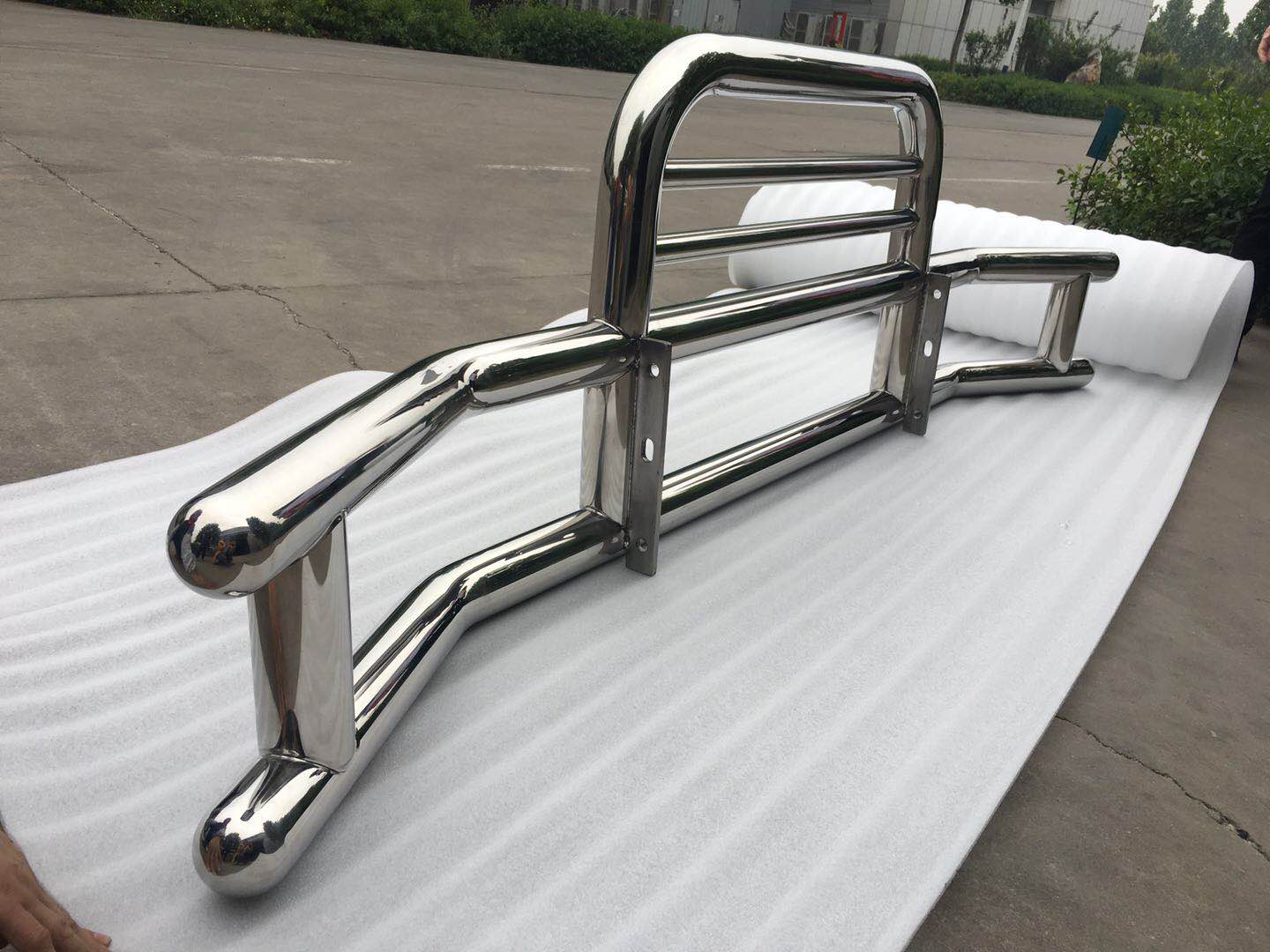
Does your bumper need a stacked dime weld?
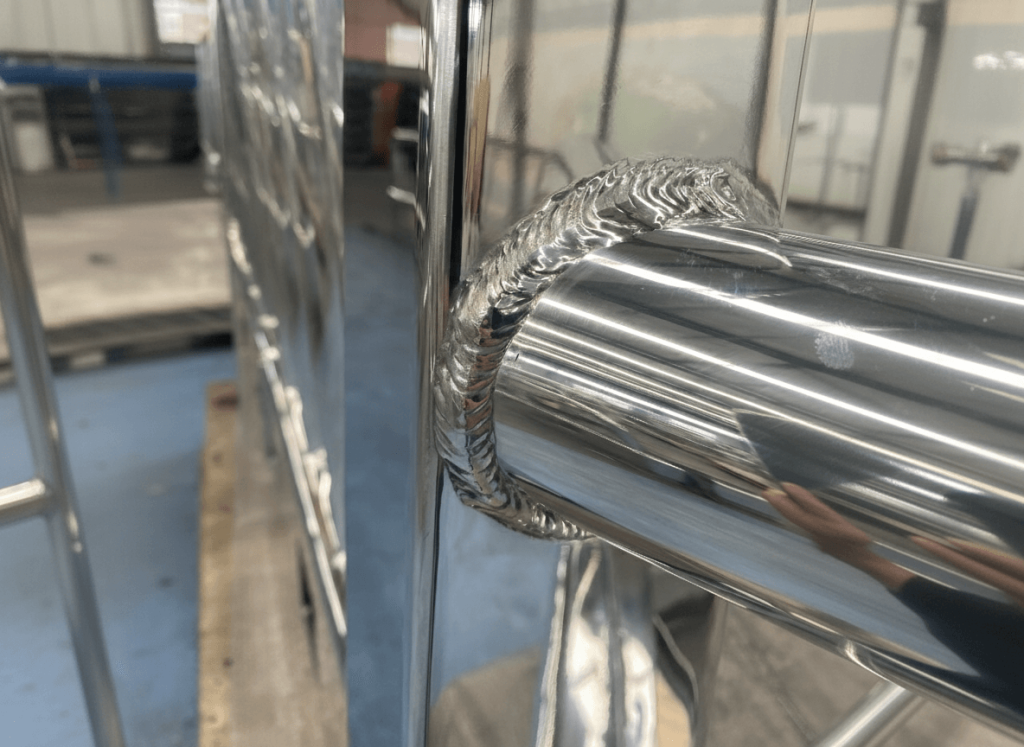
Your bumper needs a stacked dime weld if you want to achieve the absolute highest standard of front-end truck protection and visual appeal. For off-road pickups and class 8 trucks operating in harsh wildlife zones, a clean bead is a clear sign of professional-grade structural integrity. Selecting premium guards ensures your fleet remains safe and looks exceptionally sharp.
Why do heavy-duty fleets prioritize clean welds?
When your trucks are running long-haul routes through extreme northern climates, front-end collisions with wildlife can cause catastrophic downtime. But that’s not all; a poorly welded bumper will shatter upon impact, destroying your engine and putting your drivers at serious risk.
Investing in premium, meticulously welded protective guards is the smartest way to safeguard your fleet.
- Impact absorption: Distributes collision forces evenly across the frame.
- Corrosion resistance: Protects against harsh winter road salts.
- High resale value: Enhances the visual presence of your trucks.
Key Takeaway: Purchasing bumpers with flawless, high-penetration welds minimizes collision-related downtime and protects your valuable equipment.
| Attribute | Standard Bumper | Premium Welded Bumper |
|---|---|---|
| Weld Pattern | Irregular, rough | Perfect overlapping dimes |
| Impact Rating | Low to moderate | Extreme load-tested |
Choosing heavy-duty truck guards with verified structural welds protects your drivers and eliminates costly downtime.
Mastering the Shop’s Gold Standard
Achieving the perfect stacked dime weld is a journey of patience, muscle memory, and meticulous attention to detail. It represents the intersection where robust structural engineering meets high-end industrial artistry. By focusing on consistent travel speeds, maintaining precise torch angles, and keeping your hand movements perfectly synchronized, you can elevate your fabrication quality to professional standards.
When you need heavy-duty fabrications—such as premium moose bumpers, grille guards, and custom trailers—that require both ultimate strength and flawless aesthetic presentation, you need a partner with elite capabilities. To discuss your next high-precision manufacturing or custom fabrication project, contact us today to partner with our team of expert craftsmen.
Frequently Asked Questions
Can I achieve a stacked dime weld on heavy-duty class 8 truck bumpers?
Yes, you absolutely can, but it requires specialized pre-heating techniques and commercial-grade inverter setups to handle thick aluminum plates. Due to aluminum’s high thermal conductivity, you must dump heat into the metal rapidly while maintaining a steady physical cadence to prevent the joint from cooling too fast.
What’s the best shielding gas to use for clean aluminum welds?
100% pure Argon is the optimal choice because it provides superior arc stability and prevents surface oxidation from clouding your ripples. Pure Argon creates a clean cleaning action on aluminum surfaces, allowing the shiny metallic luster of your dimes to stand out beautifully.
How do I know if my weld puddle is too hot?
Your weld bead will appear flat, wide, and lack distinct crescent-shaped ripple boundaries. When the base metal accumulates too much heat, the puddle becomes overly fluid, causing the dimes to wash out and sag under gravity instead of freezing into neat, overlapping steps.
Can I safely use the MIG trigger-tacking technique on structural frames?
No, you should never use trigger-tacking on load-bearing components because it introduces severe cold starts and lacks structural fusion. Each time the arc is extinguished and restruck, you risk creating internal voids and poor penetration that can lead to catastrophic joint failure under heavy highway loads.